Showing posts with label Board Games. Show all posts

Monday, February 18, 2013

Eclipse: New Dawn for the Galaxy Review

Eclipse: New Dawn for the Galaxy is a board game for 2-6 players about exploring, researching new technologies, battling ancient aliens, and creating a galactic empire. Players choose to play as humans or one of the alien races. These range from intelligent plants to cyborgs to warmongering spider people. Each race has its own quirks and specializations. Humans, for example, start off with the technology to build starbases and have the best resource conversion rate. The game recommends each player choose humans for their first time out.

Before I discuss gameplay, let's talk about the actual physical game itself. This is easily the biggest box on my gaming shelf and for good reason. This veritable chest contains hundreds of game componentsships, hexes, ship upgrade parts, technology tiles, populations cubes, influence disks, ancient alien ships, etc. Everything is pretty high quality. Each hex, for example, has a unique image on it. Those who have played Twilight Imperium will likely criticize the relatively low level of detail on the ships used, but I don't think they detract from the game in any way. The sheer number of components may lead some to believe that this is a very complex game. The good news is that it's not. 
This game requires a lot of room. We had to play on the floor.

The game consists of 9 turns in total, no more, no less. Turns progress clockwise around the table as each player performs an action until they pass. These consist of explore, influence, move, research, build, and upgrade. At the beginning of the game, the board consists of a central hex with the other players' hexes surrounding it. The board grows through exploration, and the only limit to the galaxy is the number of hexes. Exploration is vital, as building new ships, researching new technologies, and upgrading your fleet requires resources. It's also risky; there's a pretty good chance that you will have to battle some ancient ships at least a few times in the course of a game, not to mention the possibility of player vs. player conflict.

Combat is simple and fast. Ships of the same type battle first, with the ones with the highest initiative shoot first. As a default, only sixes are hits and only do one damage a piece. Of course, by the end of the game, most of your ships will be tougher, faster, or more powerful depending on what you choose to research, meaning few combats are ever alike. 

Each player gets their own character sheet. 
Researching is another key component of the game. The available technologies are generated randomly, which both adds to the replay value and creates a race for the most valuable. The kinds of technology you can research range from improved hulls for your ships to wormhole generators which allow to travel to previously inaccessible hexes. 

So how exactly does one win this game? Through victory points. At the end of the ninth turn, you total the points for every hex you control, the research you've done, the ships you've destroyed, and any alliances you've made. This is one of those games where losing is just as fun as winning. There is a sense of narrative that unfolds as players take turns exploring, researching, and strengthening their empire. 

One thing I should mention is the length of this game. The box says 30 minutes per player, but I have never seen it run that fast. I would say closer to an hour per player for newbies and maybe 45 minutes for those with some familiarity. This isn't really a criticism though; just know that if you break this out, it will likely be the only game you play that day. 

Out of all the board games I've been playing lately, this is my favorite. Fans of 4X games will love this, and those who were intrigued by Twilight Imperium but put off by the complexity will find much to enjoy here. There is a fairly hefty price tag, but it's definitely worth it. 

Monday, February 4, 2013

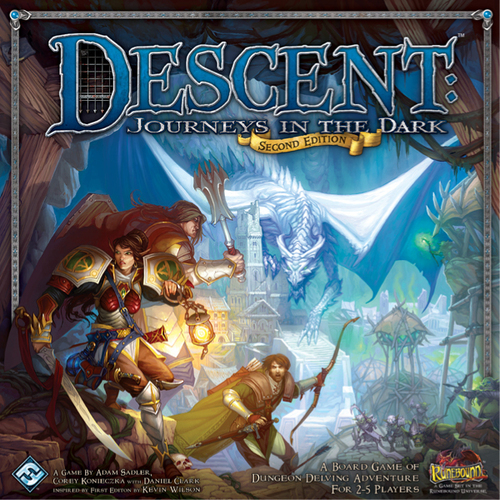
Descent: Journeys in the Dark 2nd Edition

Variety is the only staple in my gaming diet. Normally, I'm content to hop from system to system as what I want from the gaming experience changes. Imaginative pulp fantasy adventure? DCC RPG, every time. Deep character roleplaying? Burning Wheel. Intense, tactical decision making? Wargames, like Warhammer or Warmachine. Sometimes, I just want a casual adventure game that has a high depth to low complexity ratio. Descent: Journeys in the Dark 2nd Edition is that game.

Descent is basically D&D with none of the roleplaying elements and a streamlined combat system. Each game, or quest, pits a group of heroes against the Overlord as both sides struggle to progress their objectives and foil their enemy's plans. Objectives range from simple kill missions to scenario specific goals, like lighting all of the beacons to alert the castle guards of an assault. While it's true that there is no roleplaying, the simple stories that unfold really make these games feel purposeful, which isn't always the case with dungeon crawls. This sense of story is only heightened during campaign play and this is where the game really shines.

Like D&D, the heroes have four archetypes to choose from: Warrior, Healer, Mage, and Scout. Each archetype then has two classes to choose from. Warriors can choose to be a Berzerker or Knight; Mages, Runemaster or Necromancer; Scouts, Wildlander or Thief; and Healer, Disciple or Spiritspeaker. These options cover most of the standard options in fantasy roleplaying games and do offer a considerable amount of choice to the player, as each has their own unique skill tree. One of the most exciting parts of campaign play is using the accrued experience to purchase new skills.
The detail of miniatures is pretty high, particularly for the heroes. 

The Overlord also earns experience. In addition to controlling all of the monster on the map, the Overlord has a deck from which they draw traps, events, and other effects to tip the odds in their favor. As the Overlord gains experience, they can purchase new cards and further customize their deck.

The board is assembled from interlocking tiles. There are A LOT of tiles. 
Mechanically, the game is very easy to pick up. I ran a total of six quests this weekend, three in two different groups. By the end of the first quest, each group had a solid grasp of how to play. Combat is simple without being too base; roll to hit, spend surges (indicated by lightning bolts on the dice) to increase damage or add effects like stun or poison, and the defender rolls defense. The  attack dice are slightly confusing to interpret initially because each side may have a combination of a numeral, a number of hearts, and lightning bolts. The defense dice, on the other hand, just have a number of shields. You resolve combat by subtracting the number of shields rolled from the number of hearts, applying the remaining hearts as damage.

One of the things I really liked is that dedicated healer's are not a necessity, which is almost never true in D&D. If the Overlord reduces you to 0 health, you can spend a turn to Stand Up, recover some health, and you're back in the fight the following turn. Without a healer, the number of knockouts tends to snowball, but smart players can prevent the initial KO from happening by avoiding unnecessary fights and focusing on the objectives.

Interested parties may be put off by the price. $80 for a board game is expensive, but between the sheer number of high quality components and the replay value, there is a huge bang for your buck. The game comes with 20 quests, but there is a lot of room for customization for creative players. By comparison, a set of the core rulebooks for D&D or Pathfinder is going to run you a little more, and, if you enjoy the tactical elements of those games you can't go wrong with Descent: Journeys in the Dark.