
Showing posts with label Orcs. Show all posts
Showing posts with label Orcs. Show all posts
Friday, August 24, 2012
The Greenskins Get Official
Look at this character sheet one of my players made for the Orc class I designed:


Wednesday, July 25, 2012
The Rage of the Orcs: First Impressions
I posted a rough draft of my Orc class for DCC RPG two weeks back. Last night, we finished our first playtests of the mechanics. As it stands, they are just a little too powerful. When designing the mechanics, I imposed steep penalties for fatigue to discourage players from holding in their rage. The mechanics as written currently give too many bonuses to prevent players from accessing the higher bonuses on the rage table.
The player suggested scaling back the mechanics, but I've already done that: anyone using these rules should omit the Will, Morale, Threat, and AC columns. It's too many abilities. I think the bell curve works, but the speed and ease at which Rage builds is the issue. I have a few solutions in mind. The first one is a suggestion from a member of the Goodman Games forums. Rather than track rage at all, the player chooses to get a bonus to the rage roll for a penalty for the fatigue check. This is very simple and has far less bookkeeping than my current system. The only question is, how do you set limits on a bonus?
Another simple method is to just use your level as the modifier. This knocks the weakest entry on the table (1) off, and scales well until the last few levels. Using this method, here is the range of possible results.
My only issue is it removes the feel of the class. I like that players build rage, and I think there's something fun about watching those bonuses stack up. It does provide pretty defined parameters though and removes the headache of bookkeeping. I did find that my player often forgot to note the bonuses as they accrued.
The last solution involves keeping the mechanics as they are, but, rather than giving a bonus per each instance of a condition (players dropping to 0, killing enemies, critical hits, etc), the Orc can only receive +1 per each condition fulfilled (+5) in total, which scales as follows:
This gives the Orc the possibility to access some of the higher values on the Rage table than the second method above, but also makes it harder to hit the top results than the second method. Given the nature of the Rage mechanic, I don't necessarily view this as a bad thing, but it may just not work in practice. More reports to come.
The player suggested scaling back the mechanics, but I've already done that: anyone using these rules should omit the Will, Morale, Threat, and AC columns. It's too many abilities. I think the bell curve works, but the speed and ease at which Rage builds is the issue. I have a few solutions in mind. The first one is a suggestion from a member of the Goodman Games forums. Rather than track rage at all, the player chooses to get a bonus to the rage roll for a penalty for the fatigue check. This is very simple and has far less bookkeeping than my current system. The only question is, how do you set limits on a bonus?
Another simple method is to just use your level as the modifier. This knocks the weakest entry on the table (1) off, and scales well until the last few levels. Using this method, here is the range of possible results.
Level
|
Rage Die
|
Result
|
1
|
1d3
|
2-4
|
2
|
1d4
|
3-6
|
3
|
1d5
|
4-8
|
4
|
1d6
|
5-10
|
5
|
1d7
|
6-12
|
6
|
1d8
|
7-14
|
7
|
1d10
|
8-17
|
8
|
1d12
|
9-20
|
9
|
1d14
|
10-23
|
10
|
1d16
|
11-26
|
My only issue is it removes the feel of the class. I like that players build rage, and I think there's something fun about watching those bonuses stack up. It does provide pretty defined parameters though and removes the headache of bookkeeping. I did find that my player often forgot to note the bonuses as they accrued.
The last solution involves keeping the mechanics as they are, but, rather than giving a bonus per each instance of a condition (players dropping to 0, killing enemies, critical hits, etc), the Orc can only receive +1 per each condition fulfilled (+5) in total, which scales as follows:
Level
|
Rage Die
|
Result
|
1
|
1d3
|
1-8
|
2
|
1d4
|
1-9
|
3
|
1d5
|
1-10
|
4
|
1d6
|
1-11
|
5
|
1d7
|
1-12
|
6
|
1d8
|
1-13
|
7
|
1d10
|
1-15
|
8
|
1d12
|
1-17
|
9
|
1d14
|
1-19
|
10
|
1d16
|
1-21
|
This gives the Orc the possibility to access some of the higher values on the Rage table than the second method above, but also makes it harder to hit the top results than the second method. Given the nature of the Rage mechanic, I don't necessarily view this as a bad thing, but it may just not work in practice. More reports to come.
Wednesday, July 11, 2012
The Green Tide
Orc
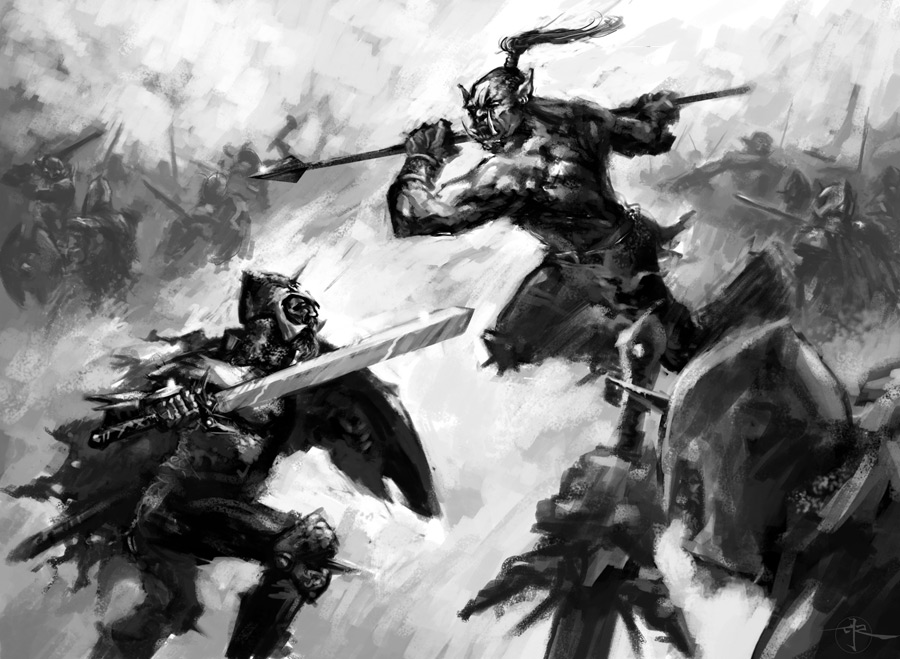
Hit Die: Orcs gain 1d12 hit points at each level.
Alignment: Orc society is scattered and unorganized. It tends to be structured around roving war bands, with the strongest assuming the leader. Of course, this does not last very long, and most Orcs perish not from a well-aimed strike by their enemies, but by the cold, crooked knife of one of their inferiors. For this reason, Orcs are mostly Chaotic. Occasionally, Orcs separate themselves from the barbarism of their brethren and are Neutral. These arrangements are often familial in structure. Orcs are almost never Lawful, and those who are generally are the product of exile, capture, or orphanhood.
Weapon Training: Orcs are trained to use the battleaxe, blackjack, club, handaxe, javelin, mace, shortbow, shortsword, spear, longbow, longsword, two-handed sword, and the warhammer.
Level
|
Attack*
|
Crit Die/Table
|
Action Dice
|
Ref
|
Fort
|
Will
|
Rage Die
|
1
|
+1
|
1d10/III
|
1d20
|
+1
|
+1
|
+0
|
1d3
|
2
|
+1
|
1d12/III
|
1d20
|
+1
|
+1
|
+0
|
1d4
|
3
|
+2
|
1d14/III
|
1d20
|
+1
|
+2
|
+1
|
1d5
|
4
|
+2
|
1d16/IV
|
1d20
|
+2
|
+2
|
+1
|
1d6
|
5
|
+3
|
1d20/IV
|
1d20+1d14
|
+2
|
+3
|
+1
|
1d7
|
6
|
+3
|
1d24/V
|
1d20+1d16
|
+2
|
+4
|
+2
|
1d8
|
7
|
+4
|
1d30/V
|
1d20+1d20
|
+3
|
+4
|
+2
|
1d10
|
8
|
+4
|
1d30/V
|
1d20+1d20
|
+3
|
+5
|
+2
|
1d12
|
9
|
+5
|
2d20/V
|
1d20+1d20
|
+3
|
+5
|
+3
|
1d14
|
10
|
+5
|
2d20/V
|
1d20+1d20+1d14
|
+4
|
+6
|
+3
|
1d16
|
Rage: The Orcs have built their reputation, not on their combat prowess, but on their ability to channel their hatred and malice into raw power. An Orc may enter a Rage at any point during a combat, even when it is not their turn. To determine the extent of an Orc's rage, roll the appropriate Rage Die, modified by the following:
- +1 for each creature the party kills
- +1 for each critical hit a party member lands
- +1 for each critical hit a party member suffers
- +1 for each fumble a party member suffers
- +1 for each party member who is dropped to 0 hit points
Rage
|
Atk/Dmg
|
HP
|
Fort
|
Will
|
DR
|
AC
|
Morale*
|
Speed
|
Threat
|
Action Dice
|
1
|
+1
|
+1
|
-
|
-
|
-
|
-
|
-
|
-
|
-
|
-
|
2
|
+2
|
+2
|
+1
|
-
|
-
|
-
|
-
|
-
|
-
|
-
|
3
|
+2
|
+3
|
+1
|
+1
|
-
|
-
|
-
|
-
|
-
|
-
|
4
|
+3
|
+4
|
+2
|
+1
|
-1
|
-
|
-
|
-
|
-
|
-
|
5
|
+4
|
+5
|
+2
|
+1
|
-1
|
+1
|
-1
|
-
|
-
|
-
|
6
|
+4
|
+6
|
+3
|
+2
|
-1
|
+1
|
-1
|
+10 ft.
|
-
|
-
|
7
|
+5
|
+7
|
+3
|
+2
|
-1
|
+1
|
-1
|
+10 ft.
|
19-20
|
-
|
8
|
+6
|
+8
|
+4
|
+2
|
-2
|
+1
|
-1
|
+10 ft.
|
19-20
|
-
|
9
|
+6
|
+9
|
+4
|
+3
|
-2
|
+1
|
-1
|
+10 ft.
|
19-20
|
-
|
10
|
+7
|
+10
|
+5
|
+3
|
-2
|
+2
|
-2
|
+10 ft.
|
19-20
|
+1d14
|
11
|
+8
|
+11
|
+5
|
+3
|
-2
|
+2
|
-2
|
+10 ft.
|
19-20
|
+1d14
|
12
|
+8
|
+12
|
+6
|
+4
|
-3
|
+2
|
-2
|
+10 ft.
|
19-20
|
+1d14
|
13
|
+9
|
+13
|
+6
|
+4
|
-3
|
+2
|
-2
|
+20 ft.
|
19-20
|
+1d14
|
14
|
+10
|
+14
|
+7
|
+4
|
-3
|
+2
|
-2
|
+20 ft.
|
18-20
|
+1d14
|
15
|
+10
|
+15
|
+7
|
+5
|
-3
|
+3
|
-3
|
+20 ft.
|
18-20
|
+1d16
|
16
|
+11
|
+16
|
+8
|
+5
|
-4
|
+3
|
-3
|
+20 ft.
|
18-20
|
+1d16
|
17
|
+12
|
+17
|
+8
|
+5
|
-4
|
+3
|
-3
|
+20 ft.
|
18-20
|
+1d16
|
18
|
+12
|
+18
|
+9
|
+6
|
-4
|
+3
|
-3
|
+20 ft.
|
18-20
|
+1d16
|
19
|
+13
|
+19
|
+9
|
+6
|
-4
|
+3
|
-3
|
+20 ft.
|
18-20
|
+1d16
|
20+
|
+14
|
+20
|
+10
|
+6
|
-5
|
+4
|
-4, Fearful Presence
(DC 20)
|
+30 ft.
1st in
Initiative
|
17-20
|
+1d20
|
*Applies to enemy morale checks
A rage lasts for a number of rounds equal to the Rage Die result (maximum 20). After a Rage ends, the Orc must make a fortitude save (DC = Rage Check + 1/per rage that day) or become fatigued. Fatigued Orcs suffer -1 to all action dice, all skill checks are made untrained, and speed is reduced to half. This condition lasts for a number of turns equal to the margin of failure. Clerics who heal this condition are treated as if they rolled a natural 1 on a lay on hands check. While fatigued, Orcs may not enter a rage.
I Smell Man Flesh!: Orcs have an uncanny ability to smell flesh and blood. Orcs can smell any creature with either within 100 ft. Orcs can identify a creature they are familiar with by scent alone on a successful Luck check.
Initiative: Orcs spend their whole lives learning the art of war. While wielding two-handed weapons, they may roll 1d20 for initiative.
Subscribe to:
Posts (Atom)