Monday, April 15, 2013

Microscope Review

I was very surprised when my one of the players/GMs in my weekly group invited me to play Microscope this past weekend. This game, which bills itself as a "a fractal roleplaying game of epic histories" is an entirely diceless game without a game master. Which, given that we've been playing DCC RPG for the better part of a year now, is quite the change of pace.

You begin the game by making a statement about the situation at hand. This is going to be the focus of the entire game. This is statement should be larger than a singular event but more of a paradigm shift. Things like, "aliens contact humanity" or "humanity mutates into demi-humans." We went with, "magic enters the world." From there, you make a list of things that are in the setting and things that are banned from the setting. One of things we made mandatory is what we dubbed "arcane pollution", which is that every use of magic saps the land of life. Things we banned included native fantasy creatures and wizard schools.

From there, you pick a starting period and ending period and decide if it is "light" or "dark". These two periods bookend the entirety of the game. Nothing that happens can pre-date the starting period and there is no conceivable future beyond the ending period. During each round, one player takes the role of the lens. That person writes a statement of focus, which all actions have to engage with in some way. The lens may make two actions and add either a new period and event or add a new event and a scene and everyone else may make one action. Periods account for decades or hundreds of years, events happen within periods and may represent stretches of time, and scenes attempt to answer questions through roleplaying.

While that may sound fairly simple, it took our group a little time to get into the rhythm of the game. Writing those statements, creating the milieu, as well as the starting and ending periods is fairly difficult. At the beginning, it felt very much not like a game and more akin to the process of sketching out the basic architecture for your game world with a few friends. Once we got into the actual game of creating periods, placing events, and playing out scenes, the game came alive.
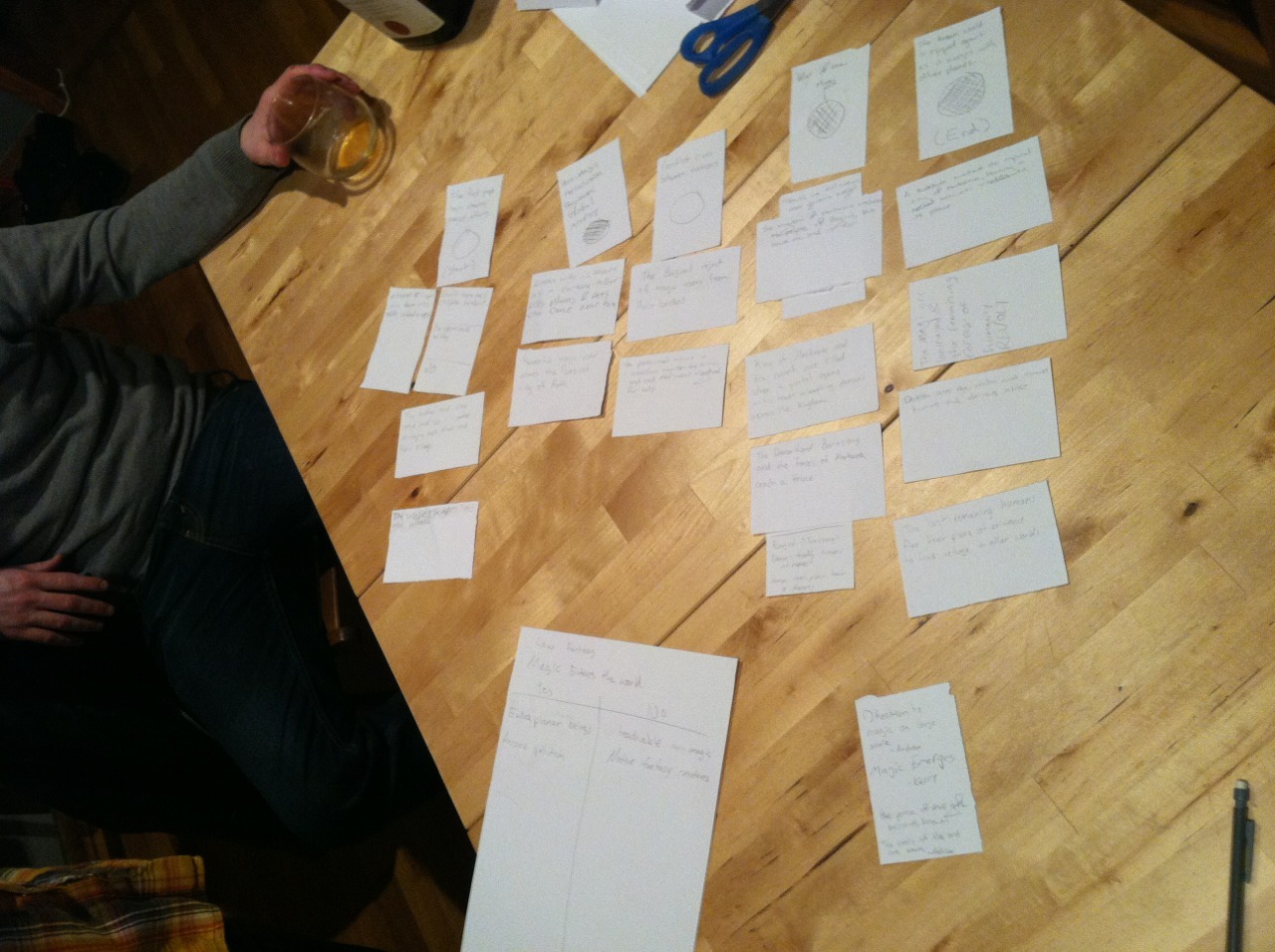
This is what a finished game looks like, whiskey not included.
Where the game really shines is in the scenes. The player writing the scene asks a question, chooses a location, and makes a list of required characters as well as banned characters. Everyone claims a role and you play the action out until that question is answered. The rules for this are very loose. If you want to affect another character, you state what you attempt to do and the character being affected chooses how that plays out. During one of our scenes during the War of the Magi, after the nation of Merkavia successfully eradicated the people of Baguul for expelling all magic users, the king pondered the question, "should we cleanse our own population of the ungifted?" Despite pleas from the vizier and his leading general, I decided this was our course of action. 

Our game ended with a sinkhole swallowing the capitol city of Merkavia and leaving a portal between worlds in its wake. The final events were the emergence of deities smiting both demons and humans alike while a precious few escaped to the next plane of existence. 

I highly, highly recommend you snag this game. The rulebook is a scant 81 pages but there is some serious fun to be had as you and your friends create a world, its Armageddon  and throw the whole thing into the waste basket at the end of the night. 

Friday, April 12, 2013

The Role of the GM or How I Learned to Stop Telling the Story and Love the Challenge Part II

The answers to these questions bring your world to life, but all of those details are wasted if you can't answer the most important question in any game: why do the players care? What is at stake if they fail? Succeed? It's not enough to threaten the city, the kingdom, or the world with a tough monster. Stacking loot for the sake of stacking loot feels incredibly purposeless. Deciding the fate of a cursed child won't have any gravity if there isn't some tangible connection that player's feel.

When players care about the in-game situation, they make decisions. They drive the narrative. The opposite is also true: players who don't care about the in-game situation still make decisions. They ignore the GMs bait and keep fishing for something else. They take off in a totally unexpected direction. Whatever their decision, they are steering the ship.


Having read entirely too many forums and blogs related to gaming, one of the biggest fears that GMs seem to have is the players choosing to go off in a direction that was unanticipated. This is the problem of having a story that you want to tell. A bad GM reacts to this situation by railroading; a good one, rolling with the punches and improvising.

A whole other style of game, the sandbox, seeks to remedy this problem by presenting several hooks and letting the players bite the juiciest one. Not only is this style of game a lot of work (you're preparing multiple plots), I don't know that it fundamentally solves the problem of the GM having a story he or she wants to tell. While it certainly engenders more player choice, I'm not sure the amount of work it requires pays is worth it.

However, as I said, these actions and decisions cannot exist in a vacuum. They have to take place somewhere, populated by the illusions of living, breathing people (or demi-people). Rather than labor over one or several stories for your players, why not step back before any characters have been made and talk about the kind of game you all want to play?

At the beginning of this post I posited that the single most important question you need to answer is why the players care. This is by far the easiest way to answer that question. Give them a say in building the setting, the major conflicts, the immediate situation at hand. Let them incorporate relationships to the people they are saving or protecting. Let them make their own purpose, and then challenge them to fulfill it.

Wednesday, April 10, 2013

Kickstarting the Dwarven Forge

While I may have missed out on the Blade of the Iron Throne Kickstarter, there is no way I'm passing this one up. Dwarven Forge, the company that makes all those ridiculously awesome game times you see in the Penny Arcade D&D sessions and many other table tops is trying to bring the cost of their products down. For $65, you get the above, which is enough to setup a single really cool encounter area. The real bang for your buck comes in at the $120 level, where you get two sets, plus any of the other stretch goals they hit. At this moment, that's an extra 16 wall-floored pieces, 12 more floor tiles, 4 angled wall-and-floor pieces, 4 additional corner-wall-and-floor pieces, two extra doors, and four half-floor tiles. You should definitely grab a friend and split this, as you'll finally have a proper dungeon setup for all those Reaper miniatures you bought. Help stoke the flames here.

On the Horizon: Blade of the Iron Throne

It appears I just missed a Kickstarter I would definitely have backed. Blade of the Iron Throne appears to be a love letter to The Riddle of Steel RPG which was created by Jake Norwood. Norwood runs with the Burning Wheel crowd, and I've always been curious to try this RPG, particularly for its combat system. However, sometimes fate doesn't go your way and I learned about this game a day after the Kickstarter closed. To further salt the wound, the full PDF was available for download earlier this year, but has since been taken down.

There are, however two consolations here. You can still grab the beta PDF here, which I recommend you do immediately. The other thing is there is a ton of art over at the Blade of the Iron Throne website. I'm going to end this post with a small sampling of some of my favorites. Do yourself a favor and take a trek over to their site to bask in its glory.

Monday, April 8, 2013

The Role of the GM or How I Learned to Stop Telling the Story and Love the Challenge Part I

As I said in my previous post, there is a great exchange about what an RPG is, what the role of the GM is, and who controls the story over at Raven Crowking's Blog. While it seems to have turned a little ugly, this is a topic worth discussing.

Let me start by saying that I couldn't care less about the definitional aspect of this discussion. I don't need a fine delineation of what defines an RPG. Those arguments are seldom interesting and never productive (ever had the "What is Art?" discussion?). What I am interested in is what the function of the GM is and who drives the story forward. Several years ago, if you had asked me why I played these kinds of games I would have answered these questions with the same answer: the role of the GM is to tell a story and it is that person who drives the narrative. I don't believe that anymore.

My friend who rotates GM duties in our weekly DCC group and I were actually having this discussion pretty recently. He likes GMing because he likes to tell a story. He was curious why I enjoyed the role. A big part of that is simply because I've been a GM since day one of my gaming career. Immediately after finishing running my first adventure in which I, an Elven Rogue, broke into a tower to steal a precious gem for the local thieves guild, my friend handed me the Dungeon Master's Guide and Monster Manual and said, "Your turn." Now, I enjoy GMing because I enjoy challenging players.

That is the role of the GM: to challenge the players. Be it a tough monster, a dungeon littered with traps, an overgrown forest, or a moral dilemma, it is the GM's job to place obstacles in the player's path. However, these things cannot exist in a vacuum. That tough monster, was he the final baddie of the campaign or something smaller? Who set all these traps and what were they trying to hide? Why would anyone choose to go through the overgrown forest? If you choose to kill this child you are murderers, but if you let him live the great evil that he has been cursed with will awaken. What do you do?

The second part of this will go up Friday, addressing who drives the story.

Friday, April 5, 2013

What Is an RPG?

I don't have time to dig into this today, but there is great discussion unfolding on Raven Crowking's Blog. Stop by and spend your two copper. More to say next week.

Wednesday, April 3, 2013

Tales of the Fallen Empire: Update

For those lucky enough to get in on the Tales of the Fallen Empire Kickstarter, your patience has been rewarded. Backers received a link to the DM screen last week. All you other layabouts can still get in on the action for $5, and you should.

Friday, March 29, 2013

Building Your Own Mythology

Every game exists in a world, however well defined. When I was younger, I took great care and spent far too much time meticulously mapping the entirety of These realms. Most of the locales were never explored beyond this initial world-building process. Now that I'm older, I have far less time and patience for this kind of work. I also don't need to know most of these details.

But every game has to have a world in which it exists. Over the years I've slowly cobbled together my own mythology. The same major guilds, religions, kingdoms, exist all the time, but the permutations which I've arranged them in change from campaign to campaign. There is, of course, always room for expansion. If the kind of story I tell necessitates some kind of entity that doesn't exist, the mythology changes. It grows.

Perhaps someday I'll write a lot of this stuff down to set the record straight but For now I enjoy the way the story of my world changes every time I tell it, like a folk tale or a comic book.

Wednesday, March 27, 2013

Freebie Alert: Old School Hack

A table-top roleplaying system that's a hack of a hack of the original Red Box version of a certain popular hack-and-slash fantasy game. That's a lot of hacking.

Check out the full game here.