Something happened on Wednesday night in the DCC game I am playing in that has never happened before: a character committed suicide. Due to some unfortunate circumstances, one of the characters accidentally (and brutally) murdered a 13 year old girl. Later in the adventure, we were in a room with several jail cells full of zombies. That same character unleashed all of them and tried to fight them off as we ran to let him perish (it became obvious what he was doing at this point).
It's overwhelmingly been my experience that players rationalize their actions. Very often, these atrocities are simply forgotten. A choice few choose redemption. I have never seen a character commit suicide as repentance.
Still, there are two other facts which make this anomaly more interesting. As much as I love DCC RPG, I do not think of it as a system that encourages deep, character driven roleplaying. It's an imaginative adventure game and one could never develop their character beyond the implications of occupation and class choice. This is also the first time playing an RPG for this player and it's both surprising and refreshing to see someone dive headfirst into a character.
Showing posts with label character death. Show all posts
Showing posts with label character death. Show all posts
Friday, February 1, 2013

Monday, August 20, 2012
Clawing Your Way Back From the Grave
I have never been a fan of spells like Raise Dead or True Resurrection. In the past, I removed these from my games because I thought they minimized death's impact. How do players fear character death if they know they can cart their corpse down to the local temple and be up and walking again within a few hours? They don't. Removing simple magical means of resurrection presents its own problem: how does one return to the land of the living?
The DCC RPG recommends handling this matter with a quest. I think this is the right method. I've also been reading up on the megadungeon and am looking to combine these two ideas. I can't say too much right now because I'm still in the very early stages of figuring out what I want to do, but I will be working on this a lot in the coming weeks as one of my players lost his favorite character last session.
The DCC RPG recommends handling this matter with a quest. I think this is the right method. I've also been reading up on the megadungeon and am looking to combine these two ideas. I can't say too much right now because I'm still in the very early stages of figuring out what I want to do, but I will be working on this a lot in the coming weeks as one of my players lost his favorite character last session.
Wednesday, June 6, 2012
In Defense of the Deus Ex Machina
It seems a shitstorm has erupted due to a recent post over at Jeff's Gameblog. You can read the whole thing here, but the comment that received the most attention is this one:

I want to refocus the discussion by asking a simple question: is character death interesting?
With few exceptions, I find the answer to be an unequivocal no. Before we get into arguments about DMs coddling their players or verisimilitude, bear with me. Character death is not interesting because it stops the game. No matter what your position is, I think we can all agree that playing is far more interesting than not playing.
At the same time, there needs to be risks of and consequences for failure. If death is the least interesting and least desirable form of failure, what are the other options?
The easiest, most common alternative to death is to take the party hostage. This creates a lot of great opportunity for roleplaying and building character motivation. If and when your players escape, they will want to get revenge after they've been tortured or maimed. The trick is to make the reasons why they've been taken prisoner specific to their captors. Cultists have something very different in mind than Goblins, as do the ranking officers of the neighboring kingdom who believe you have valuable information.
 Giving the party a second lease on life can also be as simple as answering the following question: what does death mean in your world? Most of these games imply a universe where the gods play an active role in its function. What good is the players' devotion if their corpses get dumped in the ground with the rest of the unbelievers? Give them a chance to fight their way through the realm of the gods back to the land of the living! Even if your game doesn't have deities, it's pretty easy to create an analog to limbo where they either choose to perish or fight for their lives.
The least rewarding alternative is to have a band of NPCs conveniently swoop in and save the day, At its worst, it's going to look exactly like that: convenience. The important questions to answer in this situation are: why did the NPCs lend a helping hand and what did they expect to gain by doing so? This kind of help should never be free. At the same time, the cost has to be something the PCs can obviously provide.

This whole discussion is framed within a larger debate of power creep. I agree with Jeff that many modern systems start players off with far too much in the way of resources. The lowest levels of the game should feel destitute and dangerous. What I can't do is join the chorus lamenting the days when many a game were ended by the hooked blades of the Orcs. There are just more interesting ways to handle failure than tearing your player's character sheets in half and making them start anew, ad infinitum.
If by the numbers I can't murder your starting PC with a single lousy orc-stab, I don't want to play. It's that effing simple for me.There's a certain grimace to this attitude, one that very easily leads to cries of GM/Player entitlement depending on which side of the table you find yourself on. That's one of my least favorite conversations to have, honestly. The game doesn't happen without both, and driving a wedge between the two is the quickest way to ruin a group.

I want to refocus the discussion by asking a simple question: is character death interesting?
With few exceptions, I find the answer to be an unequivocal no. Before we get into arguments about DMs coddling their players or verisimilitude, bear with me. Character death is not interesting because it stops the game. No matter what your position is, I think we can all agree that playing is far more interesting than not playing.
At the same time, there needs to be risks of and consequences for failure. If death is the least interesting and least desirable form of failure, what are the other options?
The easiest, most common alternative to death is to take the party hostage. This creates a lot of great opportunity for roleplaying and building character motivation. If and when your players escape, they will want to get revenge after they've been tortured or maimed. The trick is to make the reasons why they've been taken prisoner specific to their captors. Cultists have something very different in mind than Goblins, as do the ranking officers of the neighboring kingdom who believe you have valuable information.
The least rewarding alternative is to have a band of NPCs conveniently swoop in and save the day, At its worst, it's going to look exactly like that: convenience. The important questions to answer in this situation are: why did the NPCs lend a helping hand and what did they expect to gain by doing so? This kind of help should never be free. At the same time, the cost has to be something the PCs can obviously provide.
This whole discussion is framed within a larger debate of power creep. I agree with Jeff that many modern systems start players off with far too much in the way of resources. The lowest levels of the game should feel destitute and dangerous. What I can't do is join the chorus lamenting the days when many a game were ended by the hooked blades of the Orcs. There are just more interesting ways to handle failure than tearing your player's character sheets in half and making them start anew, ad infinitum.
Friday, June 1, 2012
When the Players Fail
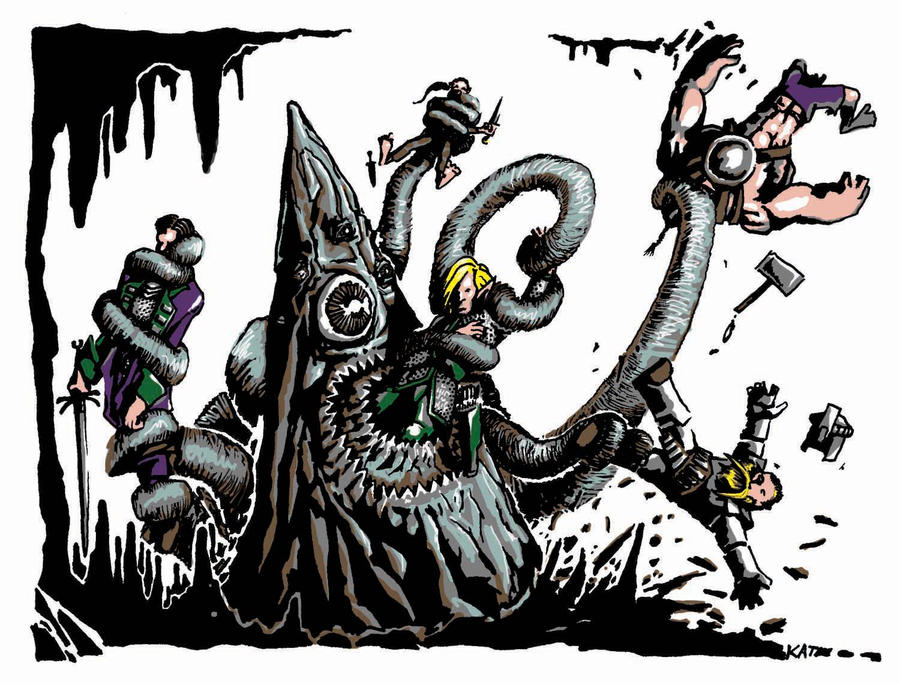
In ten years of gaming, I've only killed the entire party a handful of times. It's just not something that I, as a GM, relish. I want my players to succeed. I also want them to fail.The risk of failure that is commonly hung over the player's heads is the possibility of character death. This is a risk that needs to be there, but it should never be the only, or most frequent form that failure takes.
What made the total party kill acceptable in this case? A few things. 0-level play is particularly lethal. You have all the strength, cunning, and resources of a peasant. Heroics, like rising from the dead, feel pretty out of place here. That's not enough for me to stop a game though. The biggest deciding factor was bad player decisions.
Saturday, May 12, 2012
Dying in the First Room, Coloring Outside the Lines
Last weekend we were supposed to play the next session of the Burning Wheel Campaign, In Service of the Bastard Lord, but one of our players had to help his +1 move.
Instead, we played Pathfinder, and I actually got to be a player! It was pretty short lived; we died in the first room. I can't remember if that ever happened before, but it was not unexpected. A two-man party without a healer isn't likely to survive too long in a dungeon that the DM described as a challenge for a full party of four.
After that, we broke out my copy of Wiz-War and spent the rest of our game day chucking fireballs at one another and stealing treasure. I actually won this time.
On Tuesday I ran a solo dungeon using the DCC RPG beta rules. The one player rolled ten 0-levels, and named all of them after American political figures, actors and actresses from world cinema, and famous, dead writers. By the end of the crawl, he had two left: Barack Obama, who is now a level 1 Warrior, and Arthur Den, a level 1 Wizard. My copy of the LE rule book is on its way, I believe.
I got my sets of Gamescience dice today. Too bad all of my players are out of town, I've been dying to use them. I thought they were going to take a long time to ink, but the crayon method is super fat and easy. I'll post some pictures of them soon.
Instead, we played Pathfinder, and I actually got to be a player! It was pretty short lived; we died in the first room. I can't remember if that ever happened before, but it was not unexpected. A two-man party without a healer isn't likely to survive too long in a dungeon that the DM described as a challenge for a full party of four.
After that, we broke out my copy of Wiz-War and spent the rest of our game day chucking fireballs at one another and stealing treasure. I actually won this time.
On Tuesday I ran a solo dungeon using the DCC RPG beta rules. The one player rolled ten 0-levels, and named all of them after American political figures, actors and actresses from world cinema, and famous, dead writers. By the end of the crawl, he had two left: Barack Obama, who is now a level 1 Warrior, and Arthur Den, a level 1 Wizard. My copy of the LE rule book is on its way, I believe.
I got my sets of Gamescience dice today. Too bad all of my players are out of town, I've been dying to use them. I thought they were going to take a long time to ink, but the crayon method is super fat and easy. I'll post some pictures of them soon.
Subscribe to:
Posts (Atom)