Showing posts with label New Games. Show all posts

Friday, October 11, 2013

Torchbearer Review Part III

Calamity, Calumny, and Catastrophe

I've talked a lot about Torchbearer from the player's perspective, but the area that's most important to me as a full-time GM is how much work it takes to run an adventure. Thankfully, Torchbearer is comparable to other games in terms of time commitment to design adventures. The major difference is in how that time is spent.

Whereas other games might require you to plan a dozen or more rooms/encounter areas for a single session, a game of Torchbearer only needs a handful to thrive as players tend to spend more time engaging with each challenge. My group consistently made it through four rooms during our three-hour sessions. This means that larger dungeons will take several sessions to complete and it's plausible that an entire campaign could unfold within a single locale.

Despite this, you will still spend just as much time on those few rooms as you incorporate ways to challenge the player's beliefs, introduce interesting twists, and keep the story moving. That's the real challenge of GMing Torchbearer, turning ordinary traps and monsters into something the players care about. Some may argue that this has always been the case (and they would be right), but because Beliefs are what drive advancement, it's doubly important to learn how to present opportunities to call on those Beliefs without forcing them to do so. A simple way to encourage your players to do so is to read their Beliefs prior to making any important decision.

The other challenge is going to be rules mastery. In a previous article, I encouraged GMs to read the rules a minimum of three times. Torchbearer was the game I had in mind while giving that advice. I don't want to give the impression that this game is overly complex because it's not, but there are enough moving parts and situational rules that it does require more than one look. My general guideline for rules competency is this: you should be able to explain what every item on the character sheet is, as well as how to incorporate it into play.


Conclusion

While most games that emulate the world's most popular roleplaying game take a back-to-basics approach to rules design thanks to the OGL, Torchbearer relies on the ingenuity of more modern game design to add a fresh twist to the tried and true dungeon crawler experience. It is, admittedly, not for everyone. The sheer number of rules means there is a pretty steep learning curve, and some players may find the design philosophy jarring compared to more traditional games.

I'll close by answering the same question I asked in the first part of this review. So, what exactly is Torchbearer?

Torcbearer is a game for people who want purposeful dungeon crawling with hard rules for resource management. It is not a game about killing all the monsters and getting the treasure; rather, it is a game about what you'll risk just for the chance to rise above the squalor of the masses. Will you risk hunger, exhaustion, and your health for nothing but a rumor of gold? Are you willing to profit and suffer from the best and worst parts of your personality? Can you stand for your beliefs to be challenged, and, if they change, will you go home demoralized or embrace them just as fervently?

If you answered yes to any of those questions, this is the game for you. Now count your torches, ration your food, and swing by the Burning Wheel store for any supplies you may need.

Monday, October 7, 2013

Torchbearer Review Part I

Torchbearer made a pretty big splash a few months ago when it was announced. It got coverage in Forbes and the Kickstarter funded in less than a day (this doesn't sound that impressive, but consider that it offered nothing in the way of stretch goals). Those who backed the Kickstarter have had the PDF for a few months, and the physical books should be arriving soon (mine just came in). For everyone else who is considering throwing down for the PDF or the physical book, this is for you.

So, what exactly is Torchbearer?

From the website:
Torchbearer is a riff on the early model of fantasy roleplaying games. In it, you take on the role of a fortune-seeking adventurer. To earn that fortune, you must delve into forlorn ruins, brave terrible monsters and retrieve forgotten treasures. However, make no mistake, this game is not about being a hero or about fighting for what you believe. This game is about exploration and survival. You may become a hero. You might have to fight for your ideals. But to do either of those things, you must prove yourself in the wilds. Because there are no jobs, no inheritance, no other opportunities for your deadbeat adventurers. This life is your only hope to prosper in this world.
This description is similar to any number of games being put out by the OSR community right now. However, for whatever intentions it shares with the likes of Labyrinth Lord, Lamentations of the Flame Princess, Swords and Wizardry, DCC RPG, and countless others, Torchbearer is far more different than similar to any of those other games. It meticulously tracks turns. There are strict inventory rules. Campaigns progress through highly structured phases. You'll never roll a D20. I could go on, but let's start with the easy part: the physical book itself.


Presentation

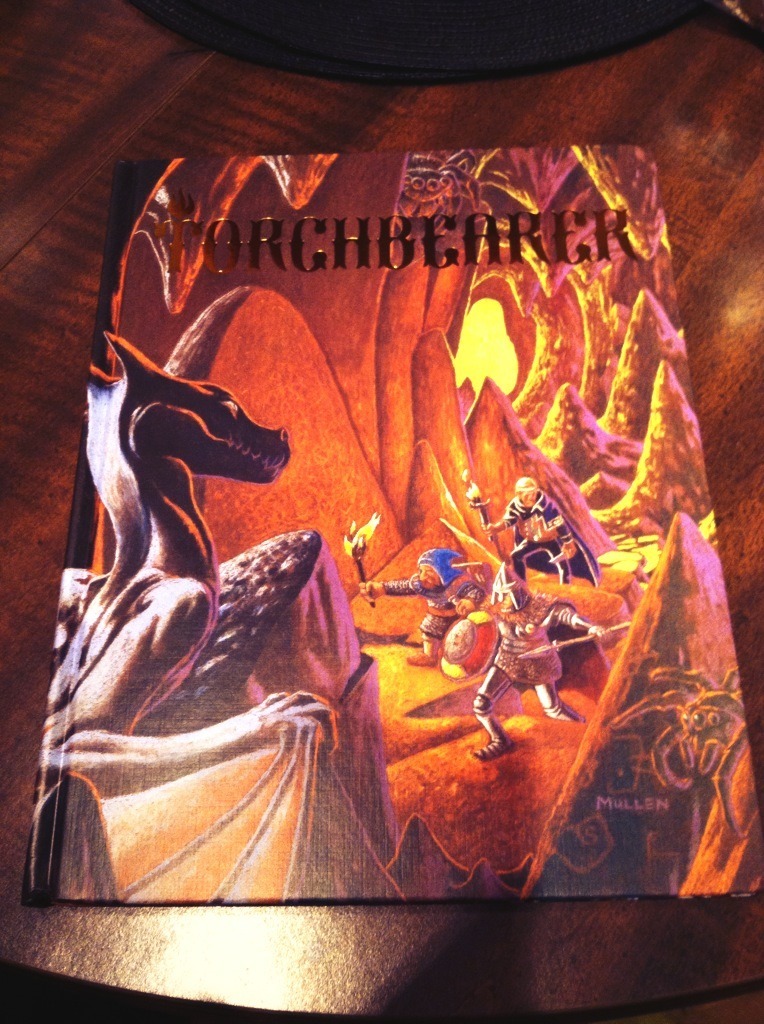
Peter Mullen, who has contributed to many of the high profile releases of the OSR community, illustrated the cover for Torchbearer. It depicts your group of typical adventurers plumbing the depth of some cavern: their weapons are drawn, their torches lit, and they stand feet away from a grinning dragon. Anyone familiar with Mullen's work can tell you that it's about as far away from the sleek stylings of Pathfinder or more recent editions of D&D. On the artwork alone, this book will fit in well next to your tattered copies of the AD&D core books.

Torchbearer takes that aesthetic one step further. Not only do the books look like they're straight out of 1978, they also feel like it. This is hard to explain, but anyone who has laid their hands on the original core books will know exactly what I'm talking about. Luke and Co. have always been about producing "books-as-artifacts", and this is no different. It's a nice touch, a subtle nod to the game's biggest source of inspiration.

The interior of the book is all black-and-white and printed on similar paper to The Burning Wheel rulebook. Torchbearer doesn't feature as much art, or as varied a style as some other OSR releases, but this is not a bad thing. Every section header has a distinct piece, and the illustrations that are placed throughout the book are all top-notch. Quality, not quantity, is the name of the game here.

The only issue, I think, is the price. Torchbearer retails for $35 and clocks in at just under 200 pages. The Burning Wheel rulebook, while printed in the smaller A6 format, is three times larger at 600 pages and only comes to $25. Personally, this isn't an issue for me, as getting a complete game for under $40 in hardcover is a steal (doubly so considering I got the PDF for that price), but I can see some gamers balking at the price of admission. Luckily, Luke and Co. have decided to offer PDFs of this game. If you're curious (or just prefer your books electronically), you can get in on the action for $15.


Character Generation

The Burning family of games has one of the best character creation systems ever designed. While not quite as robust as Burning Wheel, players build their character to be far more than a collection of stats. You answer questions about your past. Your answers determine who your friends are, who your enemies are, whether or not you have any surviving family, in addition to what skills you have picked up in your life. At the core of these games are Beliefs, Instincts, and Traits. Beliefs articulate perhaps the greatest relevant moral guideline your character lives by. Instincts are the more knee-jerk reaction part of your character. Traits play a vital role and will affect your character both negatively and positively.

Torchbearer deviates from the other games in the Burning family and includes classes. In keeping with its nod to the old days of D&D, these are race-class hybrids. Players may choose to play the Dwarf Adventurer, Elf Ranger, Halfling Burglar, or, if they choose to play a human, Cleric, Warrior, and Magician. Each class offers a standard package of skills, ability scores, traits, and weapon and armor proficiencies. Each race also offers a specific Nature. Nature is defined as three descriptors, such as Hiding, Boasting, and Remembering, and is used in place of skill or to bolster your odds of success. Players differentiate themselves through deciding their Homeland, Social Graces, Wises, and Specialties. This process is very smooth and lends itself especially well to group character creation.

The one part that I find players struggle with is writing Beliefs and Instincts. It is, admittedly, difficult to define your moral code and automatic reactions in a single neat sentence or two. In general, I've found players grasp this within a few sessions as they try to incorporate them into play and revise them as necessary. Some may find this frustrating, as advancement is linked to working these into the story, but levels in these game matter far less than in others. If a player is struggling to incorporate these into the story, they either need to be reevaluated or the GM needs to do a better job of offering situations where they might be applicable.


Torchbearer also deviates from pretty much every other game in how starting gear is purchased. To put it simply, it's not. Whereas other games allow you to equip your character according to resource points or starting gold, the only limiting factor here is what you can carry. This is brilliant. Since each item takes up an exact amount of space in your inventory and said inventory is fairly limited, players learn to make the tough decisions betweens wants and needs before even stepping foot in a dungeon. This is a useful skill to have as resource management is one of the central parts of the game.

Once characters have been made, you're ready to set out on your first adventure.

Monday, September 30, 2013

Introducing a New Game to Your Group: A 10-step Guide


1) Volunteer to GM. There's nothing worse than suggesting a game to a group and then asking someone else do the heavy lifting. If you're interested in a system buy the book/PDF, pitch it to the group, and run the game.


2) Read the rules. Take notes. Write questions that arise and cross them off as they get answered. At the end of your read through, read the relevant sections necessary to answer any remaining questions.


3) Do not make your players read the rules. This may seem counterintuitive, but it's not. Most people learned how to play at the table and requiring players to consume a tome of information is a quick way to turn the players off from the game. This bring me to my next point.


4) Read the rules. Cover to cover again, repeating the same process in step 2.


5) Make a sample character. Character creation is the first interaction most players have with the system and one of the first opportunities to establish buy-in. You want this to go as smoothly as possible. If the game you're suggesting uses multiple sub-systems, make a character that covers each major archetype. You need to be able to answer any questions players have, preferably without opening the rulebook.


6) Read the rules. Third time's a charm, right? Seriously, I can't repeat this enough. Reading the rules once or twice is probably not enough to impart the kind of mastery necessary to facilitate a game. Three complete readings is a minimum, in my opinion.


7) Use a module for the first game. Too many GMs arrogantly assume that because they have rules mastery in another system or have been GMing for X years, that they are equipped to run a new system. It doesn't work like that. While some skills will transfer (creating memorable NPCs, pacing, description), you cannot adequately prepare an adventure until you see how a game runs.


8) Provide cheat sheets for the players as well as yourself. No matter how many times you read the rules, you are going to have to reference them at some point. Cheat sheets tend to cut the fat from the book and present only the relevant information. If official cheat sheets don't exist, make them yourself.


9) Show players how to game the system. Every game has special rules and tricks for tipping the odds in the favor of the players. If an opportunity arises where you can do some rules teaching and affect the dramatic action happening, show them exactly how to do it. While some may frown on this kind of hand-holding, players are likely to feel helpless without it. Remember: building player agency creates player buy-in.


10) Don't be insulted if it doesn't work out. If you follow the above advice, all you can do is encourage your players to give it an honest shot. Play a few sessions, see the cycle of risk and reward from start to finish, and (hopefully) develop some rules mastery. However, no matter how much you may want to like a game system, it may just not be right for your group.

Friday, April 26, 2013

Luke Crane Announces Torchbearer

If you've spent any time over on the Burning Wheel Forums you may have seem mention that Luke and Co. were working on a few projects. Last week, Forbes ran a piece with the rundown on the first of these projects to see the light of day. In Luke's words, "you’re a bunch of murder hobos exploring improbable ruins because you can’t get real jobs."

Based on the article, this game is fairly close to Mouse Guard in terms of its complexity. The game borrows that system's use of conditions, and, in characteristic Burning Fashion, the game is about making hard decisions. The focus appears to be resource management, one of the biggest focuses of the older editions of dungeons and dragons.

So when can we expect it? It's slated for a release at GenCon, which is really not that far away. However, those who won't be able to attend (like me, most likely), there is plans to launch a Kickstarter. Given how much I have enjoyed his games thus far, I'll be a backer on day one.

You should give the whole article a read, which can be found here.