Showing posts with label Reviews. Show all posts
Monday, August 11, 2014
Review: Torchbearer GM Screen
GM screens are always one of the more trickier products to produce. While all accomplish the basic task of offering the GM's notes some much needed concealment, few are more than folded cardboard wrapped in some cool (or not) art. All of the good screens double as quick reference documents. I'm happy to say that the Torchbearer GM screen is one of the good ones.
The art depicts a sprawling dungeon in the typical light fantasy fare we've seen in all of the other Torchbearer products. At the upper levels are the archetypal fantasy creatures most people are familiar with: orcs, goblins, and the like. The lower levels are filled with dragons, demons, and other abominations. I particularly like this illustration because it reinforces the notion that you don't need to travel far and wide to find adventure, you just need to keep digging deeper.
This screen is smaller than the ones you normally find for use with the world's most popular roleplaying game. This is a good thing! Maybe I'm just short or need to better match my chairs to my gaming table, but I always feel like I'm straining to see over the top of those screens to make eye contact with the players. This screen provides adequate coverage without being obstructive.
One thing that did strike me as odd is that only two of three player-facing panels have art on them. The other one has the rules for conflicts printed on it. It's not an issue for me because I like the size of the screen and the art is really the least important part of this product, but I have a feeling that some may wonder if they couldn't have made a larger screen and put all of the rules on one side.
The hardest and most important part of designing a good GM screen is deciding which rules to include. Torchbearer is among the best as it includes rules for the Grind, Camp, Town, Light, Equipment (how much space they take up, how much they cost), Conflicts, and Loot tables, among other things. In short, there is not a session that goes by that almost all of the rules included do not get used, and having a quick reference to them will drastically cut down on the time spent flipping through the rulebook.
I think it speaks volumes that the only real criticism I can muster is that there is too much useful information included on the Torchbearer GM screen. Some may take issue with the size, but its utility for quick rules-reference far outweighs any form factor gripes. This product joins the Torchbearer Player's Deck as an essential play aid.
Monday, March 31, 2014
Review: Torchbearer Player's Deck
While it's true you can play most roleplaying games with nothing but some pencils, paper, and dice, most benefit from a few play aids. Maps, miniatures, other things beginning with M, these enhancements are often optional and vary based on the needs of the group. Occasionally, one of these improve the experience of the game so much it's hard to imagine playing without them. The Torchbearer Player's Deck is one such aid.
Let's look at the physical product first. For $12 you get 42 cards in a sturdy little cardboard box, one for each weapon, piece of armor, type of light source, condition, and three copies of each conflict action. Additionally, there are two dividers to separate the cards out. Each one has a rumor/story on one side and a mini-dungeon map on the other, courtesy of Tony Dowler at Year of the Dungeon.
The cards are similar in quality to a Magic: The Gathering card. The art is comparable to what you find in the Torchbearer rulebook. My only real complaint about the presentation is that it's not possible to fit all of the cards in the box if you decide to sleeve them. Not a deal-breaker, but given the price I think they could have been packaged in a bigger box.
The reason these are so vital to the game is how they streamline play. Torchbearer has so many moving parts that juggling all of the rules is going to challenge even the most seasoned of GMs. These cards help ease the burden of taking notes by keeping the rules for light and conditions right in front of you. A particularly nice touch is the numbered borders on the light cards. To track how many turns your torch, lantern, or candle have left, simply rotate the card.
Their real value becomes apparent during conflicts, which are the hardest rules to teach new players in my opinion. Each action card explains how it fits into the rock-paper-scissors mechanics, allowing players to better understand rules interactions. The weapon cards break out the bonuses and penalties, as well as any special rules they might have. The armor cards are the same. Should it ever break, players can flip it over to the "broken" side to track what they'll need to repair later. Easy and intuitive.
I honestly can't recommend these enough. If you've been playing Torchbearer without these (which is likely seeing as they've been available for less than a few days now), pick up a deck and see how it affects play. If you haven't played Torchbearer before, make sure to grab a deck with the core rulebook. You won't regret it.
Let's look at the physical product first. For $12 you get 42 cards in a sturdy little cardboard box, one for each weapon, piece of armor, type of light source, condition, and three copies of each conflict action. Additionally, there are two dividers to separate the cards out. Each one has a rumor/story on one side and a mini-dungeon map on the other, courtesy of Tony Dowler at Year of the Dungeon.
The cards are similar in quality to a Magic: The Gathering card. The art is comparable to what you find in the Torchbearer rulebook. My only real complaint about the presentation is that it's not possible to fit all of the cards in the box if you decide to sleeve them. Not a deal-breaker, but given the price I think they could have been packaged in a bigger box.
The reason these are so vital to the game is how they streamline play. Torchbearer has so many moving parts that juggling all of the rules is going to challenge even the most seasoned of GMs. These cards help ease the burden of taking notes by keeping the rules for light and conditions right in front of you. A particularly nice touch is the numbered borders on the light cards. To track how many turns your torch, lantern, or candle have left, simply rotate the card.
Their real value becomes apparent during conflicts, which are the hardest rules to teach new players in my opinion. Each action card explains how it fits into the rock-paper-scissors mechanics, allowing players to better understand rules interactions. The weapon cards break out the bonuses and penalties, as well as any special rules they might have. The armor cards are the same. Should it ever break, players can flip it over to the "broken" side to track what they'll need to repair later. Easy and intuitive.
I honestly can't recommend these enough. If you've been playing Torchbearer without these (which is likely seeing as they've been available for less than a few days now), pick up a deck and see how it affects play. If you haven't played Torchbearer before, make sure to grab a deck with the core rulebook. You won't regret it.
Friday, October 11, 2013
Torchbearer Review Part III
Calamity, Calumny, and Catastrophe
I've talked a lot about Torchbearer from the player's perspective, but the area that's most important to me as a full-time GM is how much work it takes to run an adventure. Thankfully, Torchbearer is comparable to other games in terms of time commitment to design adventures. The major difference is in how that time is spent.
Whereas other games might require you to plan a dozen or more rooms/encounter areas for a single session, a game of Torchbearer only needs a handful to thrive as players tend to spend more time engaging with each challenge. My group consistently made it through four rooms during our three-hour sessions. This means that larger dungeons will take several sessions to complete and it's plausible that an entire campaign could unfold within a single locale.
Despite this, you will still spend just as much time on those few rooms as you incorporate ways to challenge the player's beliefs, introduce interesting twists, and keep the story moving. That's the real challenge of GMing Torchbearer, turning ordinary traps and monsters into something the players care about. Some may argue that this has always been the case (and they would be right), but because Beliefs are what drive advancement, it's doubly important to learn how to present opportunities to call on those Beliefs without forcing them to do so. A simple way to encourage your players to do so is to read their Beliefs prior to making any important decision.
The other challenge is going to be rules mastery. In a previous article, I encouraged GMs to read the rules a minimum of three times. Torchbearer was the game I had in mind while giving that advice. I don't want to give the impression that this game is overly complex because it's not, but there are enough moving parts and situational rules that it does require more than one look. My general guideline for rules competency is this: you should be able to explain what every item on the character sheet is, as well as how to incorporate it into play.
Conclusion
While most games that emulate the world's most popular roleplaying game take a back-to-basics approach to rules design thanks to the OGL, Torchbearer relies on the ingenuity of more modern game design to add a fresh twist to the tried and true dungeon crawler experience. It is, admittedly, not for everyone. The sheer number of rules means there is a pretty steep learning curve, and some players may find the design philosophy jarring compared to more traditional games.
I'll close by answering the same question I asked in the first part of this review. So, what exactly is Torchbearer?
Torcbearer is a game for people who want purposeful dungeon crawling with hard rules for resource management. It is not a game about killing all the monsters and getting the treasure; rather, it is a game about what you'll risk just for the chance to rise above the squalor of the masses. Will you risk hunger, exhaustion, and your health for nothing but a rumor of gold? Are you willing to profit and suffer from the best and worst parts of your personality? Can you stand for your beliefs to be challenged, and, if they change, will you go home demoralized or embrace them just as fervently?
If you answered yes to any of those questions, this is the game for you. Now count your torches, ration your food, and swing by the Burning Wheel store for any supplies you may need.
Monday, October 7, 2013
Torchbearer Review Part I
Torchbearer made a pretty big splash a few months ago when it was announced. It got coverage in Forbes and the Kickstarter funded in less than a day (this doesn't sound that impressive, but consider that it offered nothing in the way of stretch goals). Those who backed the Kickstarter have had the PDF for a few months, and the physical books should be arriving soon (mine just came in). For everyone else who is considering throwing down for the PDF or the physical book, this is for you.
So, what exactly is Torchbearer?
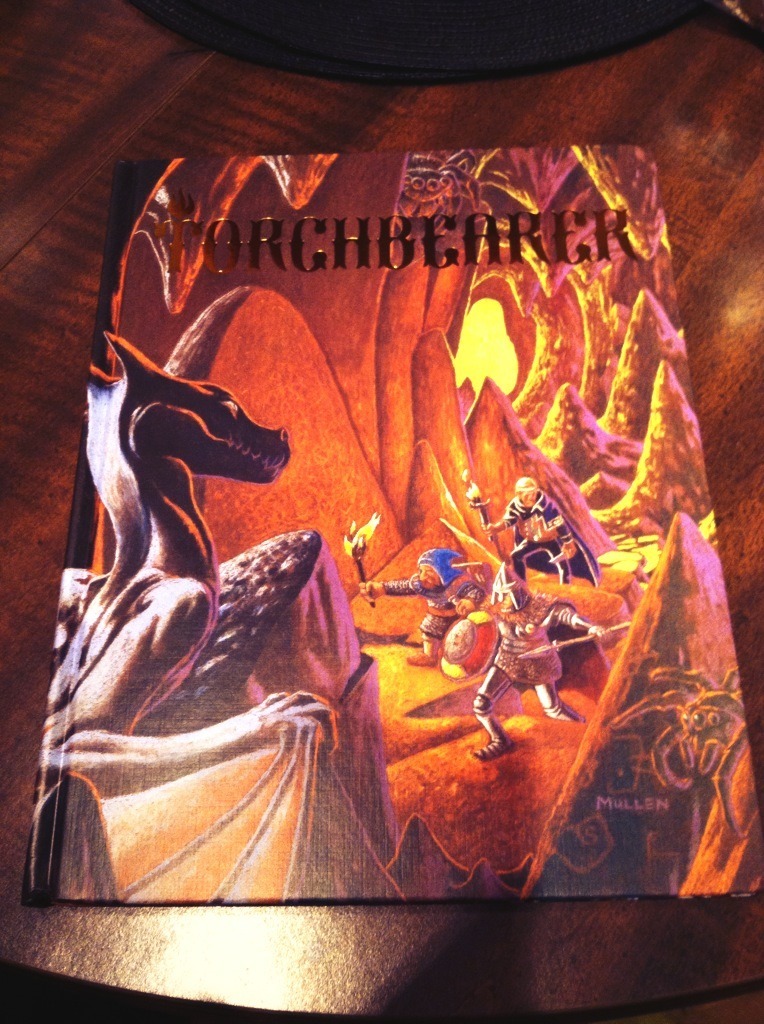
Peter Mullen, who has contributed to many of the high profile releases of the OSR community, illustrated the cover for Torchbearer. It depicts your group of typical adventurers plumbing the depth of some cavern: their weapons are drawn, their torches lit, and they stand feet away from a grinning dragon. Anyone familiar with Mullen's work can tell you that it's about as far away from the sleek stylings of Pathfinder or more recent editions of D&D. On the artwork alone, this book will fit in well next to your tattered copies of the AD&D core books.
Torchbearer takes that aesthetic one step further. Not only do the books look like they're straight out of 1978, they also feel like it. This is hard to explain, but anyone who has laid their hands on the original core books will know exactly what I'm talking about. Luke and Co. have always been about producing "books-as-artifacts", and this is no different. It's a nice touch, a subtle nod to the game's biggest source of inspiration.
The interior of the book is all black-and-white and printed on similar paper to The Burning Wheel rulebook. Torchbearer doesn't feature as much art, or as varied a style as some other OSR releases, but this is not a bad thing. Every section header has a distinct piece, and the illustrations that are placed throughout the book are all top-notch. Quality, not quantity, is the name of the game here.
The only issue, I think, is the price. Torchbearer retails for $35 and clocks in at just under 200 pages. The Burning Wheel rulebook, while printed in the smaller A6 format, is three times larger at 600 pages and only comes to $25. Personally, this isn't an issue for me, as getting a complete game for under $40 in hardcover is a steal (doubly so considering I got the PDF for that price), but I can see some gamers balking at the price of admission. Luckily, Luke and Co. have decided to offer PDFs of this game. If you're curious (or just prefer your books electronically), you can get in on the action for $15.
The Burning family of games has one of the best character creation systems ever designed. While not quite as robust as Burning Wheel, players build their character to be far more than a collection of stats. You answer questions about your past. Your answers determine who your friends are, who your enemies are, whether or not you have any surviving family, in addition to what skills you have picked up in your life. At the core of these games are Beliefs, Instincts, and Traits. Beliefs articulate perhaps the greatest relevant moral guideline your character lives by. Instincts are the more knee-jerk reaction part of your character. Traits play a vital role and will affect your character both negatively and positively.
Torchbearer deviates from the other games in the Burning family and includes classes. In keeping with its nod to the old days of D&D, these are race-class hybrids. Players may choose to play the Dwarf Adventurer, Elf Ranger, Halfling Burglar, or, if they choose to play a human, Cleric, Warrior, and Magician. Each class offers a standard package of skills, ability scores, traits, and weapon and armor proficiencies. Each race also offers a specific Nature. Nature is defined as three descriptors, such as Hiding, Boasting, and Remembering, and is used in place of skill or to bolster your odds of success. Players differentiate themselves through deciding their Homeland, Social Graces, Wises, and Specialties. This process is very smooth and lends itself especially well to group character creation.
The one part that I find players struggle with is writing Beliefs and Instincts. It is, admittedly, difficult to define your moral code and automatic reactions in a single neat sentence or two. In general, I've found players grasp this within a few sessions as they try to incorporate them into play and revise them as necessary. Some may find this frustrating, as advancement is linked to working these into the story, but levels in these game matter far less than in others. If a player is struggling to incorporate these into the story, they either need to be reevaluated or the GM needs to do a better job of offering situations where they might be applicable.
Torchbearer also deviates from pretty much every other game in how starting gear is purchased. To put it simply, it's not. Whereas other games allow you to equip your character according to resource points or starting gold, the only limiting factor here is what you can carry. This is brilliant. Since each item takes up an exact amount of space in your inventory and said inventory is fairly limited, players learn to make the tough decisions betweens wants and needs before even stepping foot in a dungeon. This is a useful skill to have as resource management is one of the central parts of the game.
Once characters have been made, you're ready to set out on your first adventure.
So, what exactly is Torchbearer?
From the website:
Torchbearer is a riff on the early model of fantasy roleplaying games. In it, you take on the role of a fortune-seeking adventurer. To earn that fortune, you must delve into forlorn ruins, brave terrible monsters and retrieve forgotten treasures. However, make no mistake, this game is not about being a hero or about fighting for what you believe. This game is about exploration and survival. You may become a hero. You might have to fight for your ideals. But to do either of those things, you must prove yourself in the wilds. Because there are no jobs, no inheritance, no other opportunities for your deadbeat adventurers. This life is your only hope to prosper in this world.This description is similar to any number of games being put out by the OSR community right now. However, for whatever intentions it shares with the likes of Labyrinth Lord, Lamentations of the Flame Princess, Swords and Wizardry, DCC RPG, and countless others, Torchbearer is far more different than similar to any of those other games. It meticulously tracks turns. There are strict inventory rules. Campaigns progress through highly structured phases. You'll never roll a D20. I could go on, but let's start with the easy part: the physical book itself.
Presentation
Peter Mullen, who has contributed to many of the high profile releases of the OSR community, illustrated the cover for Torchbearer. It depicts your group of typical adventurers plumbing the depth of some cavern: their weapons are drawn, their torches lit, and they stand feet away from a grinning dragon. Anyone familiar with Mullen's work can tell you that it's about as far away from the sleek stylings of Pathfinder or more recent editions of D&D. On the artwork alone, this book will fit in well next to your tattered copies of the AD&D core books.
Torchbearer takes that aesthetic one step further. Not only do the books look like they're straight out of 1978, they also feel like it. This is hard to explain, but anyone who has laid their hands on the original core books will know exactly what I'm talking about. Luke and Co. have always been about producing "books-as-artifacts", and this is no different. It's a nice touch, a subtle nod to the game's biggest source of inspiration.
The interior of the book is all black-and-white and printed on similar paper to The Burning Wheel rulebook. Torchbearer doesn't feature as much art, or as varied a style as some other OSR releases, but this is not a bad thing. Every section header has a distinct piece, and the illustrations that are placed throughout the book are all top-notch. Quality, not quantity, is the name of the game here.
The only issue, I think, is the price. Torchbearer retails for $35 and clocks in at just under 200 pages. The Burning Wheel rulebook, while printed in the smaller A6 format, is three times larger at 600 pages and only comes to $25. Personally, this isn't an issue for me, as getting a complete game for under $40 in hardcover is a steal (doubly so considering I got the PDF for that price), but I can see some gamers balking at the price of admission. Luckily, Luke and Co. have decided to offer PDFs of this game. If you're curious (or just prefer your books electronically), you can get in on the action for $15.
Character Generation
The Burning family of games has one of the best character creation systems ever designed. While not quite as robust as Burning Wheel, players build their character to be far more than a collection of stats. You answer questions about your past. Your answers determine who your friends are, who your enemies are, whether or not you have any surviving family, in addition to what skills you have picked up in your life. At the core of these games are Beliefs, Instincts, and Traits. Beliefs articulate perhaps the greatest relevant moral guideline your character lives by. Instincts are the more knee-jerk reaction part of your character. Traits play a vital role and will affect your character both negatively and positively.
Torchbearer deviates from the other games in the Burning family and includes classes. In keeping with its nod to the old days of D&D, these are race-class hybrids. Players may choose to play the Dwarf Adventurer, Elf Ranger, Halfling Burglar, or, if they choose to play a human, Cleric, Warrior, and Magician. Each class offers a standard package of skills, ability scores, traits, and weapon and armor proficiencies. Each race also offers a specific Nature. Nature is defined as three descriptors, such as Hiding, Boasting, and Remembering, and is used in place of skill or to bolster your odds of success. Players differentiate themselves through deciding their Homeland, Social Graces, Wises, and Specialties. This process is very smooth and lends itself especially well to group character creation.
The one part that I find players struggle with is writing Beliefs and Instincts. It is, admittedly, difficult to define your moral code and automatic reactions in a single neat sentence or two. In general, I've found players grasp this within a few sessions as they try to incorporate them into play and revise them as necessary. Some may find this frustrating, as advancement is linked to working these into the story, but levels in these game matter far less than in others. If a player is struggling to incorporate these into the story, they either need to be reevaluated or the GM needs to do a better job of offering situations where they might be applicable.
Torchbearer also deviates from pretty much every other game in how starting gear is purchased. To put it simply, it's not. Whereas other games allow you to equip your character according to resource points or starting gold, the only limiting factor here is what you can carry. This is brilliant. Since each item takes up an exact amount of space in your inventory and said inventory is fairly limited, players learn to make the tough decisions betweens wants and needs before even stepping foot in a dungeon. This is a useful skill to have as resource management is one of the central parts of the game.
Once characters have been made, you're ready to set out on your first adventure.
Monday, April 15, 2013
Microscope Review
I was very surprised when my one of the players/GMs in my weekly group invited me to play Microscope this past weekend. This game, which bills itself as a "a fractal roleplaying game of epic histories" is an entirely diceless game without a game master. Which, given that we've been playing DCC RPG for the better part of a year now, is quite the change of pace.
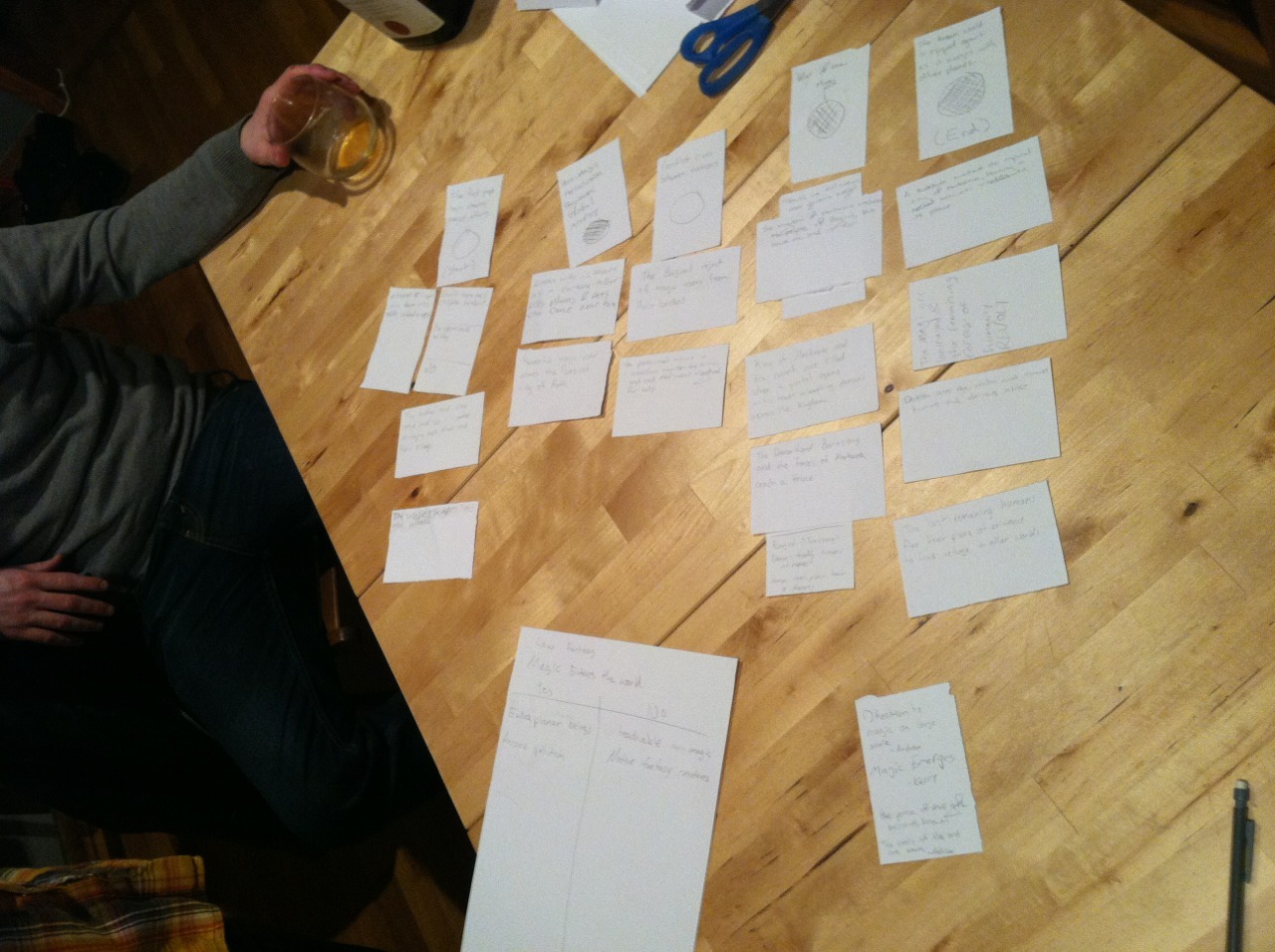
You begin the game by making a statement about the situation at hand. This is going to be the focus of the entire game. This is statement should be larger than a singular event but more of a paradigm shift. Things like, "aliens contact humanity" or "humanity mutates into demi-humans." We went with, "magic enters the world." From there, you make a list of things that are in the setting and things that are banned from the setting. One of things we made mandatory is what we dubbed "arcane pollution", which is that every use of magic saps the land of life. Things we banned included native fantasy creatures and wizard schools.
From there, you pick a starting period and ending period and decide if it is "light" or "dark". These two periods bookend the entirety of the game. Nothing that happens can pre-date the starting period and there is no conceivable future beyond the ending period. During each round, one player takes the role of the lens. That person writes a statement of focus, which all actions have to engage with in some way. The lens may make two actions and add either a new period and event or add a new event and a scene and everyone else may make one action. Periods account for decades or hundreds of years, events happen within periods and may represent stretches of time, and scenes attempt to answer questions through roleplaying.
While that may sound fairly simple, it took our group a little time to get into the rhythm of the game. Writing those statements, creating the milieu, as well as the starting and ending periods is fairly difficult. At the beginning, it felt very much not like a game and more akin to the process of sketching out the basic architecture for your game world with a few friends. Once we got into the actual game of creating periods, placing events, and playing out scenes, the game came alive.
Where the game really shines is in the scenes. The player writing the scene asks a question, chooses a location, and makes a list of required characters as well as banned characters. Everyone claims a role and you play the action out until that question is answered. The rules for this are very loose. If you want to affect another character, you state what you attempt to do and the character being affected chooses how that plays out. During one of our scenes during the War of the Magi, after the nation of Merkavia successfully eradicated the people of Baguul for expelling all magic users, the king pondered the question, "should we cleanse our own population of the ungifted?" Despite pleas from the vizier and his leading general, I decided this was our course of action.
You begin the game by making a statement about the situation at hand. This is going to be the focus of the entire game. This is statement should be larger than a singular event but more of a paradigm shift. Things like, "aliens contact humanity" or "humanity mutates into demi-humans." We went with, "magic enters the world." From there, you make a list of things that are in the setting and things that are banned from the setting. One of things we made mandatory is what we dubbed "arcane pollution", which is that every use of magic saps the land of life. Things we banned included native fantasy creatures and wizard schools.
From there, you pick a starting period and ending period and decide if it is "light" or "dark". These two periods bookend the entirety of the game. Nothing that happens can pre-date the starting period and there is no conceivable future beyond the ending period. During each round, one player takes the role of the lens. That person writes a statement of focus, which all actions have to engage with in some way. The lens may make two actions and add either a new period and event or add a new event and a scene and everyone else may make one action. Periods account for decades or hundreds of years, events happen within periods and may represent stretches of time, and scenes attempt to answer questions through roleplaying.
While that may sound fairly simple, it took our group a little time to get into the rhythm of the game. Writing those statements, creating the milieu, as well as the starting and ending periods is fairly difficult. At the beginning, it felt very much not like a game and more akin to the process of sketching out the basic architecture for your game world with a few friends. Once we got into the actual game of creating periods, placing events, and playing out scenes, the game came alive.
| This is what a finished game looks like, whiskey not included. |
Our game ended with a sinkhole swallowing the capitol city of Merkavia and leaving a portal between worlds in its wake. The final events were the emergence of deities smiting both demons and humans alike while a precious few escaped to the next plane of existence.
I highly, highly recommend you snag this game. The rulebook is a scant 81 pages but there is some serious fun to be had as you and your friends create a world, its Armageddon and throw the whole thing into the waste basket at the end of the night.
Monday, March 4, 2013
The Dungeon Alphabet Review
This was released during my hiatus from posting and I've been meaning to get to it for a few weeks now. The Dungeon Alphabet is an A-Z resource that explores the major fantasy tropes most gamers encounter in the dark places of the world. This book has actually been out for a few years now; this is an expanded third edition with about 30% more content.
Players and GMs will be familiar with most of the topics covered in this book. Altars, dragons, gold, traps, undead, pretty standard dungeon-defining elements. Each entry provides a summary, why players fear them, and the role role they play in a dungeon. The meat of each entry is the random table. If your eyes go wide at the sight of random tables, this is the book for you. This slim book is packed full tables to spruce up these well-worn dungeon elements. Essentially, this is a "how-to" manual for making your encounters interesting.
While some of the entries are going to be more useful than others, this book is really indispensable for game masters. Entries like the "100 Random Book Titles" are a great way to add detail on the fly to the otherwise nondescript musty brown tomes crowding the Wizard's bookshelf (they can't all be full of spells!). The entry on Kobolds, for example, is just one of many that add flavor to an enemy that is often encountered but seldom interesting.
Even if you don't end up using the tables as presented, just flipping through the pages of this book will have your head swimming with ideas. This is due, in part, to the absurd amount of old-school fantasy art. As with the DCC RPG rulebook, this book is a lot of fun to just aimlessly flip through due to the variety of pieces presented.
I went for the limited edition cover. The production quality of this book is similar the limited edition DCC RPG, which is to say, worth it. I tend to shy away from such purposes, but these are reference materials built to last and will look great on your bookshelf. Also, I find the original cover a little too crowded for my taste. At this point, the limited edition is probably long gone from your FLGS' shelves but I would definitely snatch it up if you happen upon this gem.
Players and GMs will be familiar with most of the topics covered in this book. Altars, dragons, gold, traps, undead, pretty standard dungeon-defining elements. Each entry provides a summary, why players fear them, and the role role they play in a dungeon. The meat of each entry is the random table. If your eyes go wide at the sight of random tables, this is the book for you. This slim book is packed full tables to spruce up these well-worn dungeon elements. Essentially, this is a "how-to" manual for making your encounters interesting.
While some of the entries are going to be more useful than others, this book is really indispensable for game masters. Entries like the "100 Random Book Titles" are a great way to add detail on the fly to the otherwise nondescript musty brown tomes crowding the Wizard's bookshelf (they can't all be full of spells!). The entry on Kobolds, for example, is just one of many that add flavor to an enemy that is often encountered but seldom interesting.
Even if you don't end up using the tables as presented, just flipping through the pages of this book will have your head swimming with ideas. This is due, in part, to the absurd amount of old-school fantasy art. As with the DCC RPG rulebook, this book is a lot of fun to just aimlessly flip through due to the variety of pieces presented.
I went for the limited edition cover. The production quality of this book is similar the limited edition DCC RPG, which is to say, worth it. I tend to shy away from such purposes, but these are reference materials built to last and will look great on your bookshelf. Also, I find the original cover a little too crowded for my taste. At this point, the limited edition is probably long gone from your FLGS' shelves but I would definitely snatch it up if you happen upon this gem.
Monday, February 4, 2013
Descent: Journeys in the Dark 2nd Edition
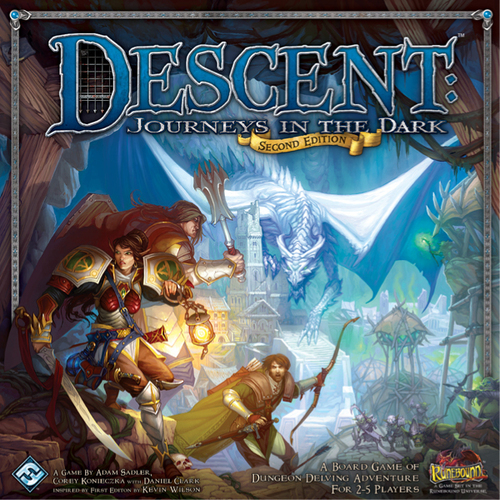
Variety is the only staple in my gaming diet. Normally, I'm content to hop from system to system as what I want from the gaming experience changes. Imaginative pulp fantasy adventure? DCC RPG, every time. Deep character roleplaying? Burning Wheel. Intense, tactical decision making? Wargames, like Warhammer or Warmachine. Sometimes, I just want a casual adventure game that has a high depth to low complexity ratio. Descent: Journeys in the Dark 2nd Edition is that game.
Descent is basically D&D with none of the roleplaying elements and a streamlined combat system. Each game, or quest, pits a group of heroes against the Overlord as both sides struggle to progress their objectives and foil their enemy's plans. Objectives range from simple kill missions to scenario specific goals, like lighting all of the beacons to alert the castle guards of an assault. While it's true that there is no roleplaying, the simple stories that unfold really make these games feel purposeful, which isn't always the case with dungeon crawls. This sense of story is only heightened during campaign play and this is where the game really shines.
Like D&D, the heroes have four archetypes to choose from: Warrior, Healer, Mage, and Scout. Each archetype then has two classes to choose from. Warriors can choose to be a Berzerker or Knight; Mages, Runemaster or Necromancer; Scouts, Wildlander or Thief; and Healer, Disciple or Spiritspeaker. These options cover most of the standard options in fantasy roleplaying games and do offer a considerable amount of choice to the player, as each has their own unique skill tree. One of the most exciting parts of campaign play is using the accrued experience to purchase new skills.
The Overlord also earns experience. In addition to controlling all of the monster on the map, the Overlord has a deck from which they draw traps, events, and other effects to tip the odds in their favor. As the Overlord gains experience, they can purchase new cards and further customize their deck.
Mechanically, the game is very easy to pick up. I ran a total of six quests this weekend, three in two different groups. By the end of the first quest, each group had a solid grasp of how to play. Combat is simple without being too base; roll to hit, spend surges (indicated by lightning bolts on the dice) to increase damage or add effects like stun or poison, and the defender rolls defense. The attack dice are slightly confusing to interpret initially because each side may have a combination of a numeral, a number of hearts, and lightning bolts. The defense dice, on the other hand, just have a number of shields. You resolve combat by subtracting the number of shields rolled from the number of hearts, applying the remaining hearts as damage.
One of the things I really liked is that dedicated healer's are not a necessity, which is almost never true in D&D. If the Overlord reduces you to 0 health, you can spend a turn to Stand Up, recover some health, and you're back in the fight the following turn. Without a healer, the number of knockouts tends to snowball, but smart players can prevent the initial KO from happening by avoiding unnecessary fights and focusing on the objectives.
Interested parties may be put off by the price. $80 for a board game is expensive, but between the sheer number of high quality components and the replay value, there is a huge bang for your buck. The game comes with 20 quests, but there is a lot of room for customization for creative players. By comparison, a set of the core rulebooks for D&D or Pathfinder is going to run you a little more, and, if you enjoy the tactical elements of those games you can't go wrong with Descent: Journeys in the Dark.
Descent is basically D&D with none of the roleplaying elements and a streamlined combat system. Each game, or quest, pits a group of heroes against the Overlord as both sides struggle to progress their objectives and foil their enemy's plans. Objectives range from simple kill missions to scenario specific goals, like lighting all of the beacons to alert the castle guards of an assault. While it's true that there is no roleplaying, the simple stories that unfold really make these games feel purposeful, which isn't always the case with dungeon crawls. This sense of story is only heightened during campaign play and this is where the game really shines.
Like D&D, the heroes have four archetypes to choose from: Warrior, Healer, Mage, and Scout. Each archetype then has two classes to choose from. Warriors can choose to be a Berzerker or Knight; Mages, Runemaster or Necromancer; Scouts, Wildlander or Thief; and Healer, Disciple or Spiritspeaker. These options cover most of the standard options in fantasy roleplaying games and do offer a considerable amount of choice to the player, as each has their own unique skill tree. One of the most exciting parts of campaign play is using the accrued experience to purchase new skills.
| The detail of miniatures is pretty high, particularly for the heroes. |
The Overlord also earns experience. In addition to controlling all of the monster on the map, the Overlord has a deck from which they draw traps, events, and other effects to tip the odds in their favor. As the Overlord gains experience, they can purchase new cards and further customize their deck.
| The board is assembled from interlocking tiles. There are A LOT of tiles. |
One of the things I really liked is that dedicated healer's are not a necessity, which is almost never true in D&D. If the Overlord reduces you to 0 health, you can spend a turn to Stand Up, recover some health, and you're back in the fight the following turn. Without a healer, the number of knockouts tends to snowball, but smart players can prevent the initial KO from happening by avoiding unnecessary fights and focusing on the objectives.
Interested parties may be put off by the price. $80 for a board game is expensive, but between the sheer number of high quality components and the replay value, there is a huge bang for your buck. The game comes with 20 quests, but there is a lot of room for customization for creative players. By comparison, a set of the core rulebooks for D&D or Pathfinder is going to run you a little more, and, if you enjoy the tactical elements of those games you can't go wrong with Descent: Journeys in the Dark.
Friday, August 10, 2012
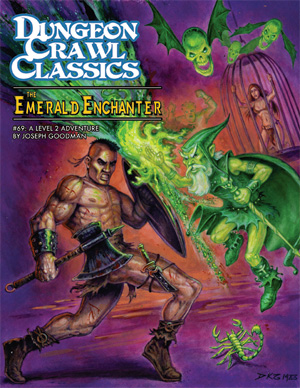
The Emerald Enchanter is Dead
I ditched the whole premise of the adventure because this group is more likely to enslave, torture, or murder the innocent than save them. Instead, I pitched it as a good opportunity to acquire some serious loot. Depending upon how much of the dungeons your players see, they could emerge from the Emerald Enchanter's citadel with a pretty heft pile of magical items. DMs may want to tone this aspect of the adventure down if they use these sparingly.
I want to highlight the second encounter in this adventure. DCC RPG stresses the unknown and the unique when it comes to monsters. DMs scratching their heads on how to accomplish this should run to their FLGS immediately and pick up The Emerald Enchanter. This encounter shows how a little twist on something familiar is all it really takes to make "just another monster" memorable for years to come.
The Emerald Enchanter nails the spirit of Appendix N adventuring and continues to prove that Goodman Games Dungeon Crawl Classics line of modules is the best on the market. DMs looking for a challenging, easy-to-insert adventure need to look no further.
Wednesday, May 30, 2012
I Sailed the Starless Sea and Lived to Tell About It
Since time immemorial you and your people have toiled in the shadow of the cyclopean ruins. Of mysterious origins and the source of many a superstition, they have always been considered a secret best left unknown by the folk of your hamlet.
But now something stirs beneath the crumbling blocks. Beastmen howl in the night and your fellow villagers are snatched from their beds. With no heroes to defend you, who will rise to stand against the encircling darkness? The secrets of Chaos are yours to unearth, but at what cost to sanity or soul?
An introductory adventure for the Dungeon Crawl Classics Roleplaying Game, Sailors on the Starless Sea pits a mob of 0-level adventurers against the legacy of the Chaos Lords and their corrupted hordes. Delving beneath the crumbling ruins, the characters discover ancient crypts, a starless sea, and an ancient ziggurat, where death and treasure await in equal measure!
So goes the pitch of the first 0-level module for the newly released Dungeon Crawl Classics RPG. I plan to cover three different things in this post: the character creation process, 0-level play, and the module itself.
As my lone player sat the gaming table throwing together a small horde of peasants it became clear: though the character creation rules may not be for everyone, they are by far the most fun of any system we have played. Let me explain. In most other RPGs, the players have a lot of say during character creation. It's pretty much the opposite in DCC RPG. With the exception of your name, everything is left up to the dice. Stats, equipment, occupation—everything else is rolled randomly.
So why is this fun? To start, it's fast. I've run a few 0-level games at this point, and generating ten characters can happen in as many minutes. This is a good thing, as most of these 0-level peasants are going to die in the first adventure. This method also produces some brilliantly insane character concepts. For example, my player rolled an Elven Sage who was incapable of speaking Elven, could not read or write, and whose only possessions were a quill pen and paper.
GMs and/or players might be tempted to skip this process and begin the game at 1st level. In the introduction to Sailors. . . the author does say this adventure would also be a suitable challenge for some 1st level characters plus a few 0-level hirelings. I would strongly recommend against doing that, especially if this is your first experience with DCC RPG or roleplaying in general. One of the strengths of 0-level play is that it's very light on rules. The amount of time wasted paging through the rulebook is non-existent. This allows you and your players to focus on the stuff that matters: the story and your characters' roles in it.
Aside from the preamble on the back and a table of rumors which your players roll on randomly (of course), little is known about the cyclopean ruins. DCC RPG thrives on the unknown, the alien, the strange. None of the creatures in Sailors are reskinned fantasy cliches. More importantly, due to (what else?) some random tables no two playthroughs of this module are going to be exactly the same.
One thing that surprised me is how many encounters and encounter areas there are for this level of play. Counting each obstacle (puzzle, trap, combat), there are a little over ten in total. The final level of the dungeon has some particularly nasty encounters. Resourceful players will have no trouble surviving these as the dungeon gives the players all the tools they need to persevere. Should players leave some parts of the dungeon unexplored they will find themselves considerably less prepared. Should players lose all of their characters, the dungeon also provides opportunity to find some new recruits.
Sailors on the Starless Sea is the perfect introductory adventure for Dungeon Crawl Classics RPG. It's got the right mixture of weirdness to fulfill its promise as the torchbearer of Appendix N fantasy roleplaying and enough charm to woo veterans and newcomers to tabletop gaming alike. It's also a good template for GMs looking to design their own 0-level adventures for this game. If you're still not convinced you should check this out, take one last look at that cover.
Monday, May 28, 2012
Crawl!
This showed up in my mailbox last week but I haven't had time to talk about it until now. For the uninitiated, Crawl! is a fanzine for the newly released Dungeon Crawl Classics RPG by Goodman Games. This is the debut issue and it's release was carefully timed to coincide with the game it's supporting. Those who per-ordered it were surprised with the black-on-black cover, a nod to the limited edition heavy metal version of DCC RPG.
Digest-sized and only 20 pages long, Crawl! is crammed full of odds and ends for both DMs and players. This issue features rules to run Human-only campaigns, Cleric-less parties, alternative skill systems, rules for how to integrate spells from older editions, and a whole new patron for your campaign. Of course, the usefulness of this material is going to vary depending upon your needs, but all of the content is top quality. I particularly like the rules for Cleric-less parties and Van den Danderclanden, a patron who has suffered extensive corruption. It's also got some neat, full page art spreads.
The entirety of this first issue is brought to us courtesy of its publisher, Reverend Dak at Stray Couches Press. He jumped into the beta tests for DCC RPG early and these variants come hot off his gaming group's table. This brings me to the best part: Crawl! takes submissions. Now that you've got your copy of DCC RPG (you do have it, right?) you're probably busy sending hordes of peasants to their death and adapting the game to your needs. Don't toil alone! Share your weird creations with the world and get involved!
Subscribe to:
Posts (Atom)