Credit goes to one of my players who also GMs from time to time.
Glancing Hit: On any attack roll where the dice total the target's AC, all damage is reduced by half, rounded down.
Penetrating Hit: On any attack roll where the dice exceed the target's AC, damage is rolled normally.
Showing posts with label DCC RPG. Show all posts
Monday, August 25, 2014
Friday, August 22, 2014
DCC RPG Variant: Thief Advancement by Guild
Of the seven available classes in DCC RPG, the Thief is the only one with a codified skill system. Naturally, these skills revolve around hiding in the shadows, pickpocketing, and stabbing things in the back. Y'know, Thief stuff. However, one of the more curious design choices was tying which ones advance to alignment. The book tries to make this more flavorful by renaming each advancement tree after a path (Path of the Boss, Path of the Assassin, Path of the Swindler), but I don't feel this adequately captures the true variety of Thiefdom. None of the three paths offered, for example, allocate the highest bonus to the Pick Lock skill.
One houserule I've been working on is advancement by Thieves' Guild. Rather than tie the skill advancement to alignment, it would be based on the flavor of the guild. Want a guild that is notorious for breaching the highest security areas in your world? Done. All the GM has to do is choose:
Of course, basing advancement on guild flavor opens up a world of possibilities. For one, having a guild with such influence on a character means a direct source for adventure. It also provides opportunity to completely customize the Thief class. In exchange for a smaller selection of skills, perhaps the player advances faster or higher in their areas of expertise. Maybe each guild has a wholly custom list of skills and abilities or favored weapons. With all of these options, I find it best to start with the the fiction and worry about how to make it work within the rules after the fact.
One houserule I've been working on is advancement by Thieves' Guild. Rather than tie the skill advancement to alignment, it would be based on the flavor of the guild. Want a guild that is notorious for breaching the highest security areas in your world? Done. All the GM has to do is choose:
- 4 Skills to receive the highest bonus
- 4 Skills to receive the second highest bonus
- 2 Skills to receive the second lowest bonus
- 2 Skills to receive the lowest bonus
- One of the two advancement tracks for Casting Spells from Scrolls
Of course, basing advancement on guild flavor opens up a world of possibilities. For one, having a guild with such influence on a character means a direct source for adventure. It also provides opportunity to completely customize the Thief class. In exchange for a smaller selection of skills, perhaps the player advances faster or higher in their areas of expertise. Maybe each guild has a wholly custom list of skills and abilities or favored weapons. With all of these options, I find it best to start with the the fiction and worry about how to make it work within the rules after the fact.
Monday, August 18, 2014
Ability Scores Above 18
As I gear up to run a DCC RPG campaign, I've been tinkering with some optional rules I want to add to my game. One of them is a mechanical benefit of ability scores above 18. Rather than simply tack on an additional +1 bonus, what if that score had a bigger impact?
If an ability score is increased above 18, either temporarily, magically, or permanently, the player may choose one of the following abilities:
- When using any ability rooted in this stat, the player rolls +1d on the die chain
- When using any ability rooted in this stat, the player rolls 2d10 instead of a D20
- If the stat is Strength or Agility, the player may re-roll damage rolls
- If the stat is Personality, a Cleric may re-roll the damage healed from their Lay on Hands check
- If the stat is Intelligence, a Wizard or Elf may re-roll their spell damage
Players must accept the second roll, even if it's worse. If a character has more than one stat above 18, the player must choose a different ability for each. Should an effect reduce the ability score to 18 or below, either temporarily, magically, or permanently, the character immediately loses access to this ability.
Monday, July 14, 2014
Kickstarter: Peril on the Purple Planet
In Peril on the Purple Planet, the characters are cast across the cosmos to a foreign world. Left to die beneath a weirdling sun and its sickening rays, the PCs’ survival depends as much upon their quick wit as a quick blade, as even the finest chain hauberk must fail beneath the crush of an alien horde.
A level 4 exploration-style adventure spanning scores of leagues, the party must contend with hundreds of miles of alien wasteland, the predatory creatures of the Purple Planet, deadly mushroom jungles, and thousands of factious savage man-beasts locked in an endless war.
In the course of the sprawling hex-crawl, the PCs will have the opportunity to assume mastery of their own warbands or pit faction against faction, plumb ancient burial mounds or respect the age-old taboos, and experiment with deadly artifacts – the remnants of the Last War. How the PCs meet each challenge will determine whether they discover the secrets to returning home, or slip beneath the sands of the wastes, succumbing to the perils of the Purple Planet.
But for those few with the courage to remain, we offer a world for the conquering.
Fund it here!
A level 4 exploration-style adventure spanning scores of leagues, the party must contend with hundreds of miles of alien wasteland, the predatory creatures of the Purple Planet, deadly mushroom jungles, and thousands of factious savage man-beasts locked in an endless war.
In the course of the sprawling hex-crawl, the PCs will have the opportunity to assume mastery of their own warbands or pit faction against faction, plumb ancient burial mounds or respect the age-old taboos, and experiment with deadly artifacts – the remnants of the Last War. How the PCs meet each challenge will determine whether they discover the secrets to returning home, or slip beneath the sands of the wastes, succumbing to the perils of the Purple Planet.
But for those few with the courage to remain, we offer a world for the conquering.
Fund it here!
Monday, May 19, 2014
Equipment Conditions in DCC RPG
One thing I've found is that players often lack for ways to spend their loot. After a few adventures they are usually able to afford any piece of gear they desire. Considering how much time is spent evenly and agreeably dividing the treasure, it should be a little more valuable. In an effort to create a much needed sense of economy and introduce some resource management into DCC RPG, I have created rules for equipment degradation.
Weapons
Weapons
Weapons have three conditions: Good Repair, Damaged, and Broken. At the end of every encounter you must test to see if your weapon degrades. Roll the weapon’s damage die. If the result comes up a 1, it degrades a condition. If it was in good repair, it is now damaged. If it was damaged, it is now broken.
Damaged weapons are not as effective in combat. Reduce all damage done by half, rounded down to a minimum of 1. Track damaged weapons on your sheet by underlining them. This is to remind you that they need to be repaired.
Broken weapons are useless until repaired. Track broken weapons by crossing them out on your character sheet. This is to remind you that you can’t use them until they’ve been repaired.
Armor has three conditions: Good Repair, Damaged, and Broken. At the end of every encounter you must test to see if your armor degrades. Roll its fumble die. If the result comes up a 1, it degrades a condition. If it was in good repair, it is now damaged. If it was damaged, it is now broken.
Damaged armor is not as effective at protecting you. Reduce it’s AC bonus by half rounded down to a minimum of +1. Track damaged armor on your sheet by underlining it. This is to remind you that it needs to be repaired.
Broken armor offers no protection. Track broken armor by crossing it out on your character sheet. This is to remind you that you can’t use it until it’s been repaired.
Tools and Other Equipment
Unlike weapons and armor, tools only have two conditions: Good Repair and Broken. After each use, you must check to see if tools are broken. Roll 1d6. On a roll of 1, the item is broken. Unless they were masterwork quality, broken tools are worthless and cannot be repaired.
Repairing Equipment
The two most common ways to repair items are through using the appropriate skill or hiring a tradesperson in town. The difficulty and cost of repair will vary according to condition and equipment is sometimes so badly damaged it cannot be restored to its former glory.
DC to repair Damaged Equipment: 10
DC to repair Broken Equipment: 15
Cost to Repair Damaged Equipment: 1/4 of Market Price
Cost to Repair Broken Equipment: 1/2 of Market Price
Weapons and armor that were broken can be repaired but only partially. Each time a broken weapon is repaired, reduce it's damage die one step down the dice chain. If this would reduce its damage die below a d3, the weapon shatters and is permanently broken.
Each time broken armor is repaired, reduce its AC bonus by 1 and its fumble die is reduced -1d on dice chain. If an armor's AC bonus is ever reduced to 0, it is too damaged to salvage.
Eventually it will just be worth it to plunk down on a new piece of gear. Better make it masterwork this time!
Masterwork Equipment
Masterwork equipment is made of sturdier stuff than its more mundane counterparts. When rolling to see if a piece of equipment degrades, players may re-roll the die if it comes up a 1. If a second 1 is rolled, then the equipment degrades. Otherwise, it remains in its current condition.
Broken masterwork weapons and armor can be repaired to their original values. The costs are the same for hiring a tradesperson, but the DC and the risk for doing it yourself is higher.
DC to repair Damaged Masterwork Equipment: 15
DC to repair Broken Masterwork Equipment: 20
Players who do not succeed on these rolls still manage to crudely repair their weapons and armor. Reduce the damage die by one on the dice chain for weapons and reduce the AC bonus by 1 for armor and decrease its fumble die -1d on the die chain permanently. It's best to leave this to the professionals!
Damaged masterwork tools and gear are only repaired on a successful roll but do not degrade
To represent this hardiness, all masterwork equipment costs twenty times the market price. Yes, I'm seriously going to charge my players 24,000 gold for a suit of masterwork full plate. Put aside these mechanics for a moment and consider what makes an item masterwork. The workmanship is only half of the equation. The other half is the raw materials. This is your chance to really instill a sense of awe and value into an item. That 24,000 suit of armor? It's made from dragonscale, and you better believe there's only one of them for sale in the entire kingdom. Players who can muster the raw materials themselves (easier said than done) will see a 50% discount.
Magic Items
Magic items follow the same degradation rules as masterwork items.
Salvaged Kit
Weapons and armor salvaged from dungeons and its denizens should have their conditions rolled randomly on the table below.
1: Broken
2-5: Damaged
6: Good Repair
For tools and other equipment, roll on this table:
1-2: Broken
3-6: Good Repair
The shops back in town aren't interested in your trash. They will only purchase items in good repair.
Repairing Equipment
The two most common ways to repair items are through using the appropriate skill or hiring a tradesperson in town. The difficulty and cost of repair will vary according to condition and equipment is sometimes so badly damaged it cannot be restored to its former glory.
DC to repair Damaged Equipment: 10
DC to repair Broken Equipment: 15
Cost to Repair Damaged Equipment: 1/4 of Market Price
Cost to Repair Broken Equipment: 1/2 of Market Price
Weapons and armor that were broken can be repaired but only partially. Each time a broken weapon is repaired, reduce it's damage die one step down the dice chain. If this would reduce its damage die below a d3, the weapon shatters and is permanently broken.
Each time broken armor is repaired, reduce its AC bonus by 1 and its fumble die is reduced -1d on dice chain. If an armor's AC bonus is ever reduced to 0, it is too damaged to salvage.
Eventually it will just be worth it to plunk down on a new piece of gear. Better make it masterwork this time!
Masterwork Equipment
Masterwork equipment is made of sturdier stuff than its more mundane counterparts. When rolling to see if a piece of equipment degrades, players may re-roll the die if it comes up a 1. If a second 1 is rolled, then the equipment degrades. Otherwise, it remains in its current condition.
Broken masterwork weapons and armor can be repaired to their original values. The costs are the same for hiring a tradesperson, but the DC and the risk for doing it yourself is higher.
DC to repair Damaged Masterwork Equipment: 15
DC to repair Broken Masterwork Equipment: 20
Players who do not succeed on these rolls still manage to crudely repair their weapons and armor. Reduce the damage die by one on the dice chain for weapons and reduce the AC bonus by 1 for armor and decrease its fumble die -1d on the die chain permanently. It's best to leave this to the professionals!
Damaged masterwork tools and gear are only repaired on a successful roll but do not degrade
To represent this hardiness, all masterwork equipment costs twenty times the market price. Yes, I'm seriously going to charge my players 24,000 gold for a suit of masterwork full plate. Put aside these mechanics for a moment and consider what makes an item masterwork. The workmanship is only half of the equation. The other half is the raw materials. This is your chance to really instill a sense of awe and value into an item. That 24,000 suit of armor? It's made from dragonscale, and you better believe there's only one of them for sale in the entire kingdom. Players who can muster the raw materials themselves (easier said than done) will see a 50% discount.
Magic Items
Magic items follow the same degradation rules as masterwork items.
Weapons and armor salvaged from dungeons and its denizens should have their conditions rolled randomly on the table below.
1: Broken
2-5: Damaged
6: Good Repair
For tools and other equipment, roll on this table:
1-2: Broken
3-6: Good Repair
The shops back in town aren't interested in your trash. They will only purchase items in good repair.
Friday, May 16, 2014
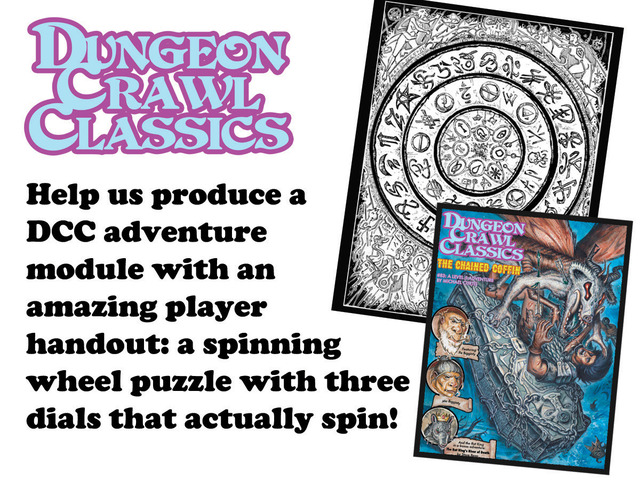
Kickstarter: DCC RPG #83 The Chained Coffin
The adventure is designed for level 5 characters. A whispered voice calls from a coffin bound in chains, urging the heroes into the depths of the Shudder Mountains, a place rife with superstition and forlorn secrets. In the shadowy, pine-grown valleys of the Deep Hollows lurk mysteries of a bygone age and a new evil emerging from the ruins of the past. The adventurers must plumb the mountains’ secluded reaches to root out this rising terror before its power comes to fruition. Standing in their path are cackling witches, subtle devils, lingering spirits, and a foul thing that moves in the night. Can the heroes appease that which lies within the Chained Coffin and thwart the dawn of a new and terrible age?
If it goes to $36,000, this module will grow into a box set. Full details here. Become a backer here.
Friday, March 14, 2014
Everybody Has One: Kickstarter Horror Stories
I interrupt my series of posts on things for your Torchbearer game to talk about Kickstarter, particularly, the projects that don't pan out. Unlike some, my investment was minimal and there is a happy ending.
A few years ago, hot on the heels of DCC RPGs release, Brave Halfling Games launched their "Appendix N Adventures" campaign. Basically, players would get a bunch of modules for a pretty low investment ($20 was the sweet spot, enough to get print and PDF copies of everything that got produced).
Two years later and I have yet to receive a single print copy of my module (PDFs have been released). Now, anyone on the inside knows John, the man behind Brave Halfling, has had an incredibly rough time since then. Couple that with his Kickstarter being more successful than I think he ever could have imagined, and I'm sympathetic to his situation. The only real thing I can fault him for is releasing print modules to stores before any of his backers received them. Aside from that, I think he did the best he could given the hand he was dealt.
That being said, I've also backed two other Kickstarters, both of them last year. Both delivered within months and both were leagues more complicated (one a full hardcover RPG, another highly detailed dungeon tiles). This is not so much a criticism as an observation.
Now for the happy ending. I had pretty much given up on this Kickstarter until I saw that Joseph Goodman, the person behind DCC RPG, was offering refunds. I reached out to Joe because I wanted some resolution. Rather than a refund, I traded my investment in the Kickstarter for a few DCC modules, which is what I wanted all along. I just want to take this time to wish John well and to thank Joseph Goodman for being an excellent human being.
A few years ago, hot on the heels of DCC RPGs release, Brave Halfling Games launched their "Appendix N Adventures" campaign. Basically, players would get a bunch of modules for a pretty low investment ($20 was the sweet spot, enough to get print and PDF copies of everything that got produced).
Two years later and I have yet to receive a single print copy of my module (PDFs have been released). Now, anyone on the inside knows John, the man behind Brave Halfling, has had an incredibly rough time since then. Couple that with his Kickstarter being more successful than I think he ever could have imagined, and I'm sympathetic to his situation. The only real thing I can fault him for is releasing print modules to stores before any of his backers received them. Aside from that, I think he did the best he could given the hand he was dealt.
That being said, I've also backed two other Kickstarters, both of them last year. Both delivered within months and both were leagues more complicated (one a full hardcover RPG, another highly detailed dungeon tiles). This is not so much a criticism as an observation.
Now for the happy ending. I had pretty much given up on this Kickstarter until I saw that Joseph Goodman, the person behind DCC RPG, was offering refunds. I reached out to Joe because I wanted some resolution. Rather than a refund, I traded my investment in the Kickstarter for a few DCC modules, which is what I wanted all along. I just want to take this time to wish John well and to thank Joseph Goodman for being an excellent human being.
Monday, May 13, 2013
Magic Item Monday: The Balance Blades
Scholars of Empyrealia and Demonology may tell the tale of two brothers who could never quite see eye to eye. One day, when their disagreement snowballed, as they often did, the two brothers decided to duel to settle their differences. For every advantage gained, each brother exposed a weakness. As the final years of their age came to a close, neither would put aside the sword and fought to their last breath. How these swords found their way to the realm of men remains a mystery.
Angelking Sword
The steel of this sword has a blue tint. For a neutral character, it functions as a +1 Longsword. For a Lawful character, it functions as +2 Weapon and has an increased threat range against chaotic opponents. Chaotic wielders still receive the +1 bonus as a neutral character, but should be treated as having the lowest luck score for the purposes of assigning hits.
Demonking Sword
The steel of this sword has a red tint. For a neutral character, it functions as a +1 Longsword. For a Chaotic characters who wield it still receive the +1 bonus, but it also heals the wielded 1d8 hit points each time a living creature is slain. Lawful wielders still receive the +1 bonus as a neutral character, but should be treated as having the lowest luck score for the purposes of assigning hits.
Those who dual-wield these weapons may get a glimpse of the true nature of these weapons. A natural roll of 1 or 20 applies to both weapons. Should both a 1 and 20 be rolled, count both swings as a miss. The luck penalty, regardless of alignment, is ignored. Other Alignment-specific abilities still function as normal. There is rumor among bards that a way exists to forge these blades anew as a single hilted, dual-bladed weapon.
Angelking Sword
The steel of this sword has a blue tint. For a neutral character, it functions as a +1 Longsword. For a Lawful character, it functions as +2 Weapon and has an increased threat range against chaotic opponents. Chaotic wielders still receive the +1 bonus as a neutral character, but should be treated as having the lowest luck score for the purposes of assigning hits.
Demonking Sword
The steel of this sword has a red tint. For a neutral character, it functions as a +1 Longsword. For a Chaotic characters who wield it still receive the +1 bonus, but it also heals the wielded 1d8 hit points each time a living creature is slain. Lawful wielders still receive the +1 bonus as a neutral character, but should be treated as having the lowest luck score for the purposes of assigning hits.
Those who dual-wield these weapons may get a glimpse of the true nature of these weapons. A natural roll of 1 or 20 applies to both weapons. Should both a 1 and 20 be rolled, count both swings as a miss. The luck penalty, regardless of alignment, is ignored. Other Alignment-specific abilities still function as normal. There is rumor among bards that a way exists to forge these blades anew as a single hilted, dual-bladed weapon.
Wednesday, April 24, 2013
More DCC Modules
I meant to fit this into Monday's post, but live in the unimagined world has been faster these past few weeks. Anyway, along with the unveiling of another limited edition cover, Goodman Games announced a few new modules slated to hit the shelves this summer. This is exciting because levels 1-2 are lacking in options, and these will certainly fill those gaps.
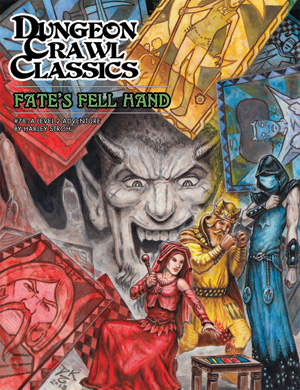
Awash in a sea of phlogiston, three wizards battle for mastery of reality! But with each new day all gains are lost and the game begins anew. It is up to the adventurers to upset this ancient balance, winning free of the shrinking demi-plane before all is reduced to the roiling stuff of raw Chaos!
Will you strike a bargain, swearing fealty to one of the fell masters? Or will you attempt to master your own fate, pitting your luck and skill against arcane foes? Whatever you decide, you must act quickly, for gray worms press in from all sides and time grows short!
An exploration-based adventure for 2nd level PCs, Fate's Fell Hand challenges new and old players alike. Only the most cunning of PCs can hope to thwart the machinations of three dire wizards and escape Fate's Fell Hand!
The second module looks interesting because it shows the clear influence of Appendix N, the weird fiction that predates the recognition of the fantasy and sci-fi (or speculative fiction, if you will) genres. Read the blurb:
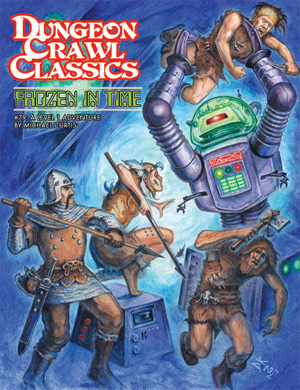
Frozen in Time is a level 1 adventure for any DCC RPG campaign. It also includes new material for judges who want to send their adventurers in a Stone Age setting!
Monday, April 22, 2013
Dungeon Crawl Classics RPG: Limited Edition Cover #3
The good folks over at Goodman Games unveiled another limited edition cover for the Dungeon Crawl Classics RPG. For those keeping count, this makes the 4th cover in about a year. Their website says it should ship in June, and those who pre-order will get an exclusive art folio featuring Stefan Poag's work.
Friday, March 22, 2013
Cover Art for Transylvanian Adventures Unveiled
Doug Kovacs, the talent responsible for the iconography of DCC RPG, is confirmed for the cover of Transylvanian Adventures, a gothic supplement for the most talked about game on this blog. This is one book of three and the rumor is that Kovacs may do the cover work for all three. I look forward to seeing it with a splash of color.
Monday, March 11, 2013
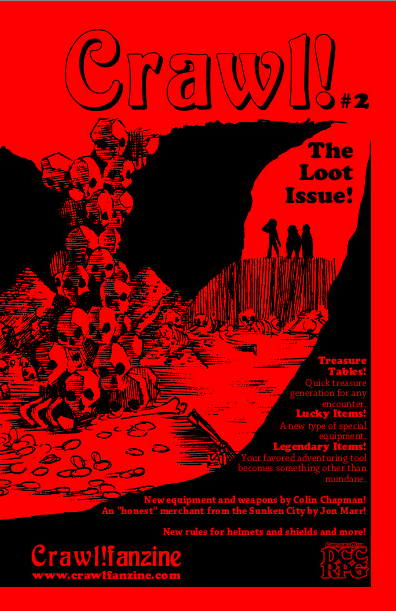
Crawl! #6 Review
The latest issue of Crawl has been out for several weeks. I've had it for several weeks, too. I was also sick right around the time I got it. Thankfully, I've kicked whatever was making feel like death and had the chance to go through this a few more times.
Crawl #6 is the end product of a contest Reverend Dak ran on the Goodman Game forums. Forumers were asked which classes they wanted to see most, then the community submitted their versions for consideration. The best Bard, Gnome, Ranger, and Paladin are featured in this issue.
One of things I really enjoy about the DCC RPG is how many archetypes fit into the four base classes. Clerics can easily fill their iconic role or play more like a Druid depending upon your alignment. Give a Warrior a pet and you're not too far away from having a Ranger. You can see where I'm going with this.
Let me start with the good. The Bard class is very well done and is one of the few classes I feel isn't covered in the four base classes. Bards can use their performances to affect their audiences. These effects might grant bonuses to will saves or act like Charm Person spell. It feels very balanced, and I will definitely be including this in my future campaigns.
I was particularly impressed by the Gnome. They are essentially slightly more Hardy Wizards with a restricted spell list to reflect their nature. Gnomes are typically the least favorite of all standard fantasy races, but I like them quite a bit. My only complaint is that this is only a five level class. The creator explains this as they usually lack the penchant for long term adventuring, but I feel this is a bad decision. Most members of the other races do not become adventurers. That's what makes them special. I will be expanding this to a full ten level class before including it in my campaign.
I have mixed feelings about the Paladin. I would best describe it as a cross between the Warrior and Cleric class. It gets a Smite Die, which functions like a Deeds die but only against unholy enemies. It casts spells and suffers disapproval as the Cleric. It also has a secondary disapproval-like table. I'm not sure I see the need for a full Paladin class. Simply rolling a Warrior with a belief in god and adding a few unique uses of the Mighty Deeds to reflect this devotion would cover it, in my opinion. I think the inclusion of more disapproval is not particularly exciting because the normal disapproval is already so punishing. Still, I think this is useful to take bits and pieces of and adapt as you see necessary.
I feel similarly about the Ranger class. It has a deeds die. It gets favored enemies. I just don't feel the need for a full class when the Warrior covers this so well. Unlike the Paladin, I don't see much in the way that there is to take and adapt.
Despite my hesitation about some of these classes, I'm never disappointed when the envelope from Stray Couches Press arrives in my mailbox. As with all community-generated content, your mileage is going to vary. If you haven't ordered it yet, you need to add this to your collection. Don't forget, Crawl! is now available in PDF form, too!
Crawl #6 is the end product of a contest Reverend Dak ran on the Goodman Game forums. Forumers were asked which classes they wanted to see most, then the community submitted their versions for consideration. The best Bard, Gnome, Ranger, and Paladin are featured in this issue.
One of things I really enjoy about the DCC RPG is how many archetypes fit into the four base classes. Clerics can easily fill their iconic role or play more like a Druid depending upon your alignment. Give a Warrior a pet and you're not too far away from having a Ranger. You can see where I'm going with this.
Let me start with the good. The Bard class is very well done and is one of the few classes I feel isn't covered in the four base classes. Bards can use their performances to affect their audiences. These effects might grant bonuses to will saves or act like Charm Person spell. It feels very balanced, and I will definitely be including this in my future campaigns.
I was particularly impressed by the Gnome. They are essentially slightly more Hardy Wizards with a restricted spell list to reflect their nature. Gnomes are typically the least favorite of all standard fantasy races, but I like them quite a bit. My only complaint is that this is only a five level class. The creator explains this as they usually lack the penchant for long term adventuring, but I feel this is a bad decision. Most members of the other races do not become adventurers. That's what makes them special. I will be expanding this to a full ten level class before including it in my campaign.
I have mixed feelings about the Paladin. I would best describe it as a cross between the Warrior and Cleric class. It gets a Smite Die, which functions like a Deeds die but only against unholy enemies. It casts spells and suffers disapproval as the Cleric. It also has a secondary disapproval-like table. I'm not sure I see the need for a full Paladin class. Simply rolling a Warrior with a belief in god and adding a few unique uses of the Mighty Deeds to reflect this devotion would cover it, in my opinion. I think the inclusion of more disapproval is not particularly exciting because the normal disapproval is already so punishing. Still, I think this is useful to take bits and pieces of and adapt as you see necessary.
I feel similarly about the Ranger class. It has a deeds die. It gets favored enemies. I just don't feel the need for a full class when the Warrior covers this so well. Unlike the Paladin, I don't see much in the way that there is to take and adapt.
Despite my hesitation about some of these classes, I'm never disappointed when the envelope from Stray Couches Press arrives in my mailbox. As with all community-generated content, your mileage is going to vary. If you haven't ordered it yet, you need to add this to your collection. Don't forget, Crawl! is now available in PDF form, too!
Monday, March 4, 2013
The Dungeon Alphabet Review
This was released during my hiatus from posting and I've been meaning to get to it for a few weeks now. The Dungeon Alphabet is an A-Z resource that explores the major fantasy tropes most gamers encounter in the dark places of the world. This book has actually been out for a few years now; this is an expanded third edition with about 30% more content.
Players and GMs will be familiar with most of the topics covered in this book. Altars, dragons, gold, traps, undead, pretty standard dungeon-defining elements. Each entry provides a summary, why players fear them, and the role role they play in a dungeon. The meat of each entry is the random table. If your eyes go wide at the sight of random tables, this is the book for you. This slim book is packed full tables to spruce up these well-worn dungeon elements. Essentially, this is a "how-to" manual for making your encounters interesting.
While some of the entries are going to be more useful than others, this book is really indispensable for game masters. Entries like the "100 Random Book Titles" are a great way to add detail on the fly to the otherwise nondescript musty brown tomes crowding the Wizard's bookshelf (they can't all be full of spells!). The entry on Kobolds, for example, is just one of many that add flavor to an enemy that is often encountered but seldom interesting.
Even if you don't end up using the tables as presented, just flipping through the pages of this book will have your head swimming with ideas. This is due, in part, to the absurd amount of old-school fantasy art. As with the DCC RPG rulebook, this book is a lot of fun to just aimlessly flip through due to the variety of pieces presented.
I went for the limited edition cover. The production quality of this book is similar the limited edition DCC RPG, which is to say, worth it. I tend to shy away from such purposes, but these are reference materials built to last and will look great on your bookshelf. Also, I find the original cover a little too crowded for my taste. At this point, the limited edition is probably long gone from your FLGS' shelves but I would definitely snatch it up if you happen upon this gem.
Players and GMs will be familiar with most of the topics covered in this book. Altars, dragons, gold, traps, undead, pretty standard dungeon-defining elements. Each entry provides a summary, why players fear them, and the role role they play in a dungeon. The meat of each entry is the random table. If your eyes go wide at the sight of random tables, this is the book for you. This slim book is packed full tables to spruce up these well-worn dungeon elements. Essentially, this is a "how-to" manual for making your encounters interesting.
While some of the entries are going to be more useful than others, this book is really indispensable for game masters. Entries like the "100 Random Book Titles" are a great way to add detail on the fly to the otherwise nondescript musty brown tomes crowding the Wizard's bookshelf (they can't all be full of spells!). The entry on Kobolds, for example, is just one of many that add flavor to an enemy that is often encountered but seldom interesting.
Even if you don't end up using the tables as presented, just flipping through the pages of this book will have your head swimming with ideas. This is due, in part, to the absurd amount of old-school fantasy art. As with the DCC RPG rulebook, this book is a lot of fun to just aimlessly flip through due to the variety of pieces presented.
I went for the limited edition cover. The production quality of this book is similar the limited edition DCC RPG, which is to say, worth it. I tend to shy away from such purposes, but these are reference materials built to last and will look great on your bookshelf. Also, I find the original cover a little too crowded for my taste. At this point, the limited edition is probably long gone from your FLGS' shelves but I would definitely snatch it up if you happen upon this gem.
Monday, February 11, 2013
Purple Sorcerer Games' Crawler's Companion Review
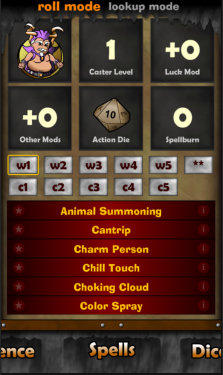
A whole slew of Kickstarter projects were announced immediately following the release of DCC RPG last year. Purple Sorcerer Games delivered their goods last week, offering a hybrid of a dice roller app and rules reference guide. The best part? The app is 100% free regardless of whether you backed the Kickstarter project.
One of the most common complaints I've read about DCC RPG is the "need" to purchase funky, expensive Zocchi dice. I've never given this complaint much validity because the rulebook outlines very simple methods of generating these results and really, what gamer doesn't love dice? Assuming you have a smartphone, this app remedies that "need". Well, sort of.
To be honest, the main dice roller interface is a little bit clunky. You roll by swiping your finger over the die towards the center of the screen. One of the features is a die-lock, which allows you to roll multiple types of dice at the same time. The problem is that dice often get locked unintentionally, meaning you'll sometimes be rolling extras. It would be better if I just had to tap the screen instead of swipe.
Another issue is that dice don't automatically disappear from the table after they've been rolled; each one is removed manually by tapping it. In a game where every class uses numerous types of dice, not having a clear-all function to remove clutter quickly can certainly be frustrating.
The main dice roller portion of the app isn't a total loss, though. When you roll multiple dice of the same type, it displays the total on a single die. Critical hits and fumbles initiates are announced via a "Natural 20" graphic and a laughing skull, respectively. The sound of rolling dice sounds like the real thing. All of these features distinguish it from being just a random number generator.
The reference portions of the app are what really shine. Spells, critical hits, and critical failures all have a mini-dice roller function with none of the aforementioned issues. Simply click on the appropriate option and displays the total of your roll and the appropriate result. You can program your modifications into these sections to account for the relevant bonuses which makes pulling the results from one of DCC's hundreds of pages of tables as simple as pressing a button.
There is also general reference section of the app that is equally useful for both new players and veterans alike. This is broken down into three sections, one for classes, combat, and general reference. One of the issues with the first printing of DCC is the lack of an index. While the second printing has remedied this, finding rules, which are still spread out over several sections, is now much faster and convenient.
Despite its flaws, Purple Sorcerer Games has given us a tool that is as essential as the rulebook itself. The issues I have with the dice roller function are certainly forgivable considering the price and nothing an update can't fix.
Wednesday, February 6, 2013
Friday, February 1, 2013
Character Suicide
Something happened on Wednesday night in the DCC game I am playing in that has never happened before: a character committed suicide. Due to some unfortunate circumstances, one of the characters accidentally (and brutally) murdered a 13 year old girl. Later in the adventure, we were in a room with several jail cells full of zombies. That same character unleashed all of them and tried to fight them off as we ran to let him perish (it became obvious what he was doing at this point).
It's overwhelmingly been my experience that players rationalize their actions. Very often, these atrocities are simply forgotten. A choice few choose redemption. I have never seen a character commit suicide as repentance.
Still, there are two other facts which make this anomaly more interesting. As much as I love DCC RPG, I do not think of it as a system that encourages deep, character driven roleplaying. It's an imaginative adventure game and one could never develop their character beyond the implications of occupation and class choice. This is also the first time playing an RPG for this player and it's both surprising and refreshing to see someone dive headfirst into a character.
It's overwhelmingly been my experience that players rationalize their actions. Very often, these atrocities are simply forgotten. A choice few choose redemption. I have never seen a character commit suicide as repentance.
Still, there are two other facts which make this anomaly more interesting. As much as I love DCC RPG, I do not think of it as a system that encourages deep, character driven roleplaying. It's an imaginative adventure game and one could never develop their character beyond the implications of occupation and class choice. This is also the first time playing an RPG for this player and it's both surprising and refreshing to see someone dive headfirst into a character.
Monday, September 24, 2012
Help! I Need Somebody!
Teamwork is one of those things that I ensure is vital to any party hoping to survive my campaign. One of the most common ways to lend a hand is on a skill check, but few systems have explicit rules on how to go about multiple characters contributing to a task. I've developed a simple system for such a situation. One character acts as the primary participant, while everyone else is support. The sole character in the primary role makes their check a normally, rolling a 1d20 (or whichever die is appropriate). Anyone in a support roll does the same, but their result modifies the overall check as follows:
1: -2 to check
5: +1 to check
10: +2 to check
15: +3 to check
20: +4 to check
1: -2 to check
5: +1 to check
10: +2 to check
15: +3 to check
20: +4 to check
Friday, September 21, 2012
DCC RPG Alternate Cover
I posted the sketch a while ago, but Joseph Goodman revealed the color version this week. Now I just need to convince myself I need a third copy of this rulebook. Or maybe I just need to convince my girlfriend that this would make a great Christmas present.
Monday, September 17, 2012
Creeping Miasma
Often disguising themselves as clouds of fog, Creeping Miasma's are the products of cult activity or evil spirits who remain on the material plain to feast on the flesh of the living. Anyone who enters the cloud immediately feels a burning sensation throughout their entire body. For each round a character spends in the cloud they suffer 1d6 points of damage.
Init +7; Atk SP (see above); AC 17; HD 10d8; HP 45; MV 30', Fly 30'; Act SP (see below); SV Fort +3, Ref +7, Will +3; AL C
Init +7; Atk Tentacle +7 (1d6); AC 17; HD 10d8; HP 45; MV 30'; Act 6d20; Any creature struck by one of the tentacles Is automatically grappled and will be thrust into its hideous mouth on the following turn unless they succeed at a DC 15 Reflex save; those who fail automatically suffer 1d6 points of damage from its bite attack; SV Fort +3, Ref +7, Will +3; AL C
Init +7; Atk SP (see above); AC 17; HD 10d8; HP 45; MV 30', Fly 30'; Act SP (see below); SV Fort +3, Ref +7, Will +3; AL C
Trying to escape a Creeping Miasma is incredibly difficult. Should its prey attempt to run, it takes the form of a massive python. While in this form, use these stats:
Init +7; Atk Bite +7 (1d8 + Poison); AC 17; HD 10d8; HP 45; MV 60'; Act 1d20; SV Fort +3, Ref +7, Will +3; AL C
Poison: This venom rots the victim's flesh from the inside out. A player bit by the snake form must succeed on a DC 15 Fort save or suffer 1d6 points of dame per round for a number of rounds equal to their margin of failure.
Should its prey, in a fit of foolish bravery, choose to stand and fight, the Creeping Miasma takes the form of a hideous, razor-toothed maw surrounded by six tentacles. While in this form, use the stats below:
All forms reduce any damage taken by half from non-magical sources.
Subscribe to:
Posts (Atom)